180 posters, 53 videos, 29 audios, 5 topics, 304 authors, 182 institutions
ePostersLive by SciGen Technologies S.A. All rights reserved.
7th Commonwealth Chemistry Posters
24-25 June, 2026 | Online

P140
Influence of Imidazolium-Based Ionic Liquids on Restructuring of Water: Role of Cationic Alkyl Chain Length
Poster Presenter
Part of Topic
Sustainable Planet (SDGs 2, 11, 13, 14 and 15)
Video
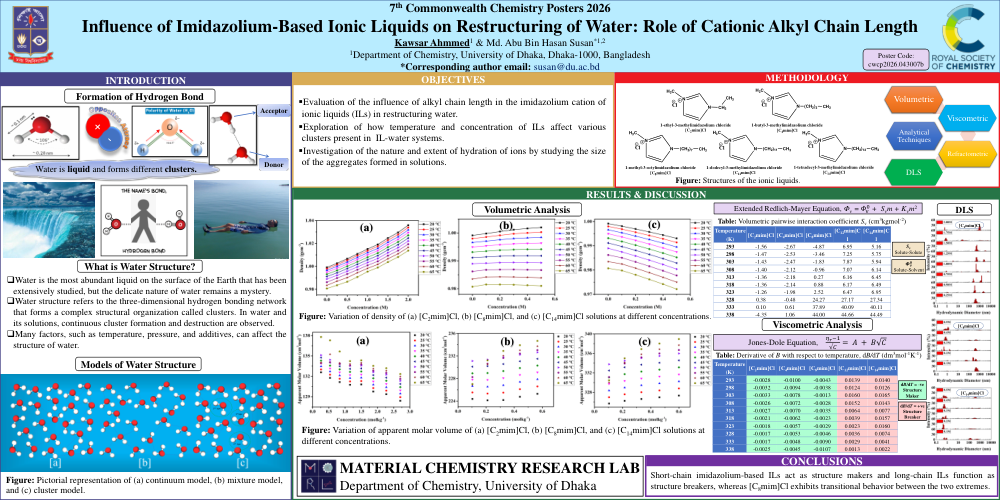
Molecular-level interactions of ionic liquids (ILs) in aqueous medium are crucial for understanding how they alter the structure of water. By carefully selecting ILs and controlling their concentration, it is possible to influence reaction pathways, leading to higher product yields or the formation of alternative products. In this work, the effect of alkyl chain length on the restructuring ability of 1-alkyl-3-methylimidazolium chloride ([Cnmim]Cl, where n = 2, 4, 8, 12, and 14) in aqueous media has been systematically investigated. When water and solutes interact, different types of clusters form, and the strength and number of hydrogen bonds in these clusters vary with the concentration of solutes. Using dynamic light scattering (DLS), the hydrodynamic diameter is measured to examine the degree of aggregation, which reveals monomodal distributions at low concentrations and temperatures (20−30 °C), while multimodal distributions at higher concentrations, particularly for n ≥ 8. Limiting partial molar volume increases significantly with alkyl chain length, ranging from ~130 cm3mol-1 for [C2mim]Cl to ~330 cm3mol-1 for [C14mim]Cl, highlighting enhanced hydrophobic contributions. The density of the IL-water system increases with concentration for shorter alkyl chains, whereas an opposite trend is observed for longer chains. Short-chain ILs exhibit negative temperature coefficients of the viscosity B-parameter (dB/dT ≈ −0.010 to −0.002 dm3mol-1K-1), confirming structure-making behavior governed by strong electrostatic hydration. Long-chain analogues display positive dB/dT values (up to +0.016 dm3mol-1K-1), indicating structure-breaking effects dominated by hydrophobic aggregation. [C8mim]Cl demonstrates transitional characteristics, shifting from hydration-dominated interactions at lower temperatures to hydrophobic aggregation at elevated temperatures. Solutions with high concentrations exhibit greater temperature sensitivity, and a distinct dichotomous behavior appears beyond 50 °C for all the IL solutions. This work enhances understanding of IL-water interactions and supports the design of greener and eco-friendly solvents to replace volatile organic solvents.