180 posters, 53 videos, 29 audios, 5 topics, 304 authors, 182 institutions
ePostersLive by SciGen Technologies S.A. All rights reserved.
7th Commonwealth Chemistry Posters
24-25 June, 2026 | Online

P121
Green Solvent-Based Sustainable Drug Formulation: A Step Toward Eco-Friendly Pharmaceutical Development
Poster Presenter
Part of Topic
Responsible Energy (SDGs 7 and 12)
Video
Audio
“Green Solvent-Based Sustainable Drug Formulation: A Step Toward Eco-Friendly Pharmaceutical Development.”
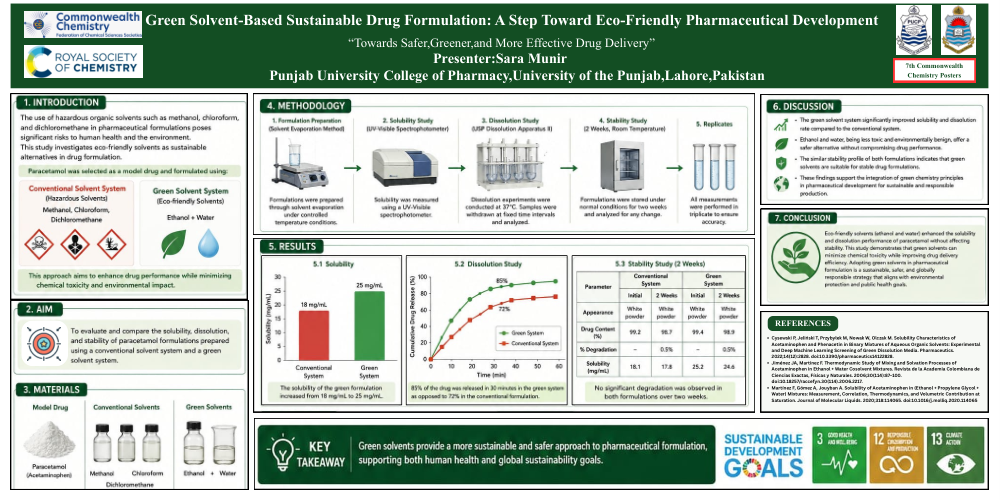
The pharmaceutical industry relies heavily on organic solvents during drug formulation and manufacturing processes. Commonly used solvents such as methanol, chloroform, and dichloromethane are effective, but they pose serious risks to both human health and the environment due to their toxicity and hazardous waste generation. Therefore, there is a growing need to develop safer and more sustainable alternatives. The objective of this study was to investigate the potential of green solvents as environmentally friendly substitutes for conventional organic solvents in pharmaceutical formulations. Paracetamol was selected as the model drug because of its widespread use and established pharmaceutical profile. For this purpose, two formulations were prepared using the solvent evaporation method. One formulation was prepared using conventional solvents, while the second formulation utilized a green solvent system consisting of ethanol and water. The prepared formulations were then evaluated for their solubility, dissolution behavior, and stability. Solubility studies were performed using a UV-Visible spectrophotometer. Dissolution testing was carried out using USP Dissolution Apparatus II at 37 degrees Celsius, and stability studies were conducted at room temperature over a period of two weeks. All experiments were performed in triplicate to ensure accuracy and reproducibility. Moving towards the results, the green solvent formulation demonstrated significantly improved performance compared to the conventional formulation. The solubility of paracetamol increased from 18 mg/mL in the conventional solvent system to 25 mg/mL in the ethanol-water system. Similarly, dissolution studies showed enhanced drug release from the green formulation. After 30 minutes, the green solvent formulation achieved approximately 85% drug release, whereas the conventional formulation showed 72% drug release. Stability studies indicated that both formulations remained stable throughout the testing period, with no significant changes observed in appearance or drug content. However, the green solvent formulation consistently maintained slightly better solubility characteristics. These findings suggest that green solvent systems can effectively improve the physicochemical performance of pharmaceutical formulations while reducing dependence on hazardous chemicals. Enhanced solubility and dissolution may also contribute to improved drug bioavailability and therapeutic effectiveness. An important aspect of this research is its contribution to the United Nations Sustainable Development Goals, or SDGs. By replacing toxic organic solvents with safer alternatives such as ethanol and water, this work supports SDG 3: Good Health and Well-being through reduced exposure to harmful chemicals. It also contributes to SDG 12: Responsible Consumption and Production by promoting environmentally responsible pharmaceutical manufacturing practices. Furthermore, reducing hazardous solvent waste helps minimize environmental pollution, supporting SDG 13: Climate Action. The decreased release of toxic substances into water and soil also contributes to SDG 14: Life Below Water and SDG 15: Life on Land by helping protect aquatic and terrestrial ecosystems. In conclusion, this study demonstrates that green solvents such as ethanol and water can serve as effective alternatives to conventional organic solvents in pharmaceutical formulations. The green solvent system improved solubility and dissolution performance while maintaining formulation stability and reducing environmental impact. Green solvent-based drug formulations offer a safer, more sustainable, and environmentally responsible approach to pharmaceutical development while maintaining or even enhancing drug performance.