180 posters, 53 videos, 29 audios, 5 topics, 304 authors, 182 institutions
ePostersLive by SciGen Technologies S.A. All rights reserved.
7th Commonwealth Chemistry Posters
24-25 June, 2026 | Online

P164
Plasmon-Driven CO2 Reduction via Hot-Electron Relay in Trimetallic Antenna-Reactor Catalysts: Mechanistic Insights and Reactor Design Principles
Poster Presenter
Authors
Affiliations
Part of Topic
Sustainable Planet (SDGs 2, 11, 13, 14 and 15)
Video
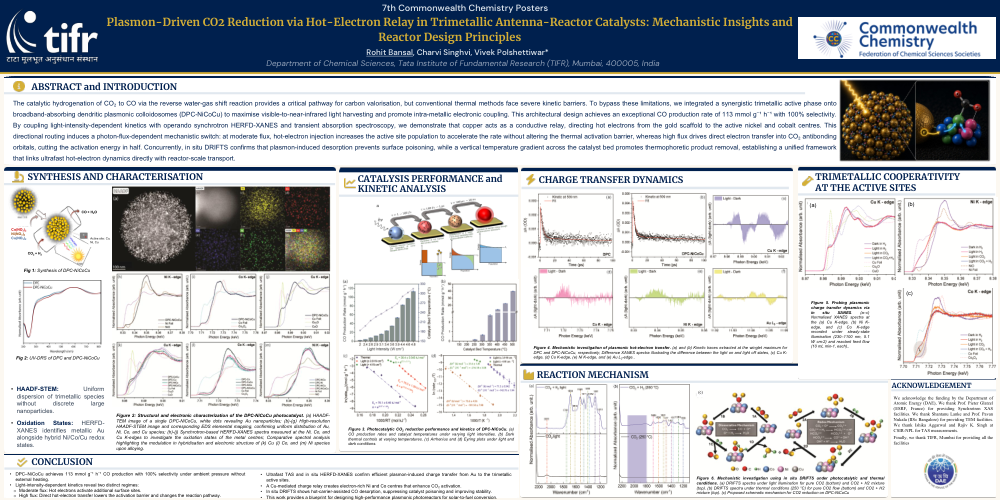
The catalytic hydrogenation of CO₂ to CO via the reverse water-gas shift reaction provides a critical pathway for carbon valorisation, but conventional thermal methods face severe kinetic barriers. To bypass these limitations, we integrated a synergistic trimetallic active phase onto broadband-absorbing dendritic plasmonic colloidosomes (DPC-NiCoCu) to maximise visible-to-near-infrared light harvesting and promote intra-metallic electronic coupling. This architectural design achieves an exceptional CO production rate of 113 mmol g⁻¹ h⁻¹ with 100% selectivity. By coupling light-intensity-dependent kinetics with operando synchrotron HERFD-XANES and transient absorption spectroscopy, we demonstrate that copper acts as a conductive relay, directing hot electrons from the gold scaffold to the active nickel and cobalt centres. This directional routing induces a photon-flux-dependent mechanistic switch: at moderate flux, hot-electron injection increases the active site population to accelerate the rate without altering the thermal activation barrier, whereas high flux drives direct electron transfer into CO₂ antibonding orbitals, cutting the activation energy in half. Concurrently, in situ DRIFTS confirms that plasmon-induced desorption prevents surface poisoning, while a vertical temperature gradient across the catalyst bed promotes thermophoretic product removal, establishing a unified framework that links ultrafast hot-electron dynamics directly with reactor-scale transport.