180 posters, 53 videos, 29 audios, 5 topics, 304 authors, 182 institutions
ePostersLive by SciGen Technologies S.A. All rights reserved.
7th Commonwealth Chemistry Posters
24-25 June, 2026 | Online

P84
Light-Initiated Continuous Flow Degradation of Per- or Polyfluoroalkyl Substances (PFAS)
Poster Presenter
Authors
Affiliations
Part of Topic
Clean Water and Sanitation (SDG 6)
Video
Light-Initiated Continuous Flow Degradation of Per- or Polyfluoroalkyl Substances (PFAS)
Rachael K. Matthews, Cameron J. Shearer
Chemistry Department, College of Sciences, Adelaide University, Australia
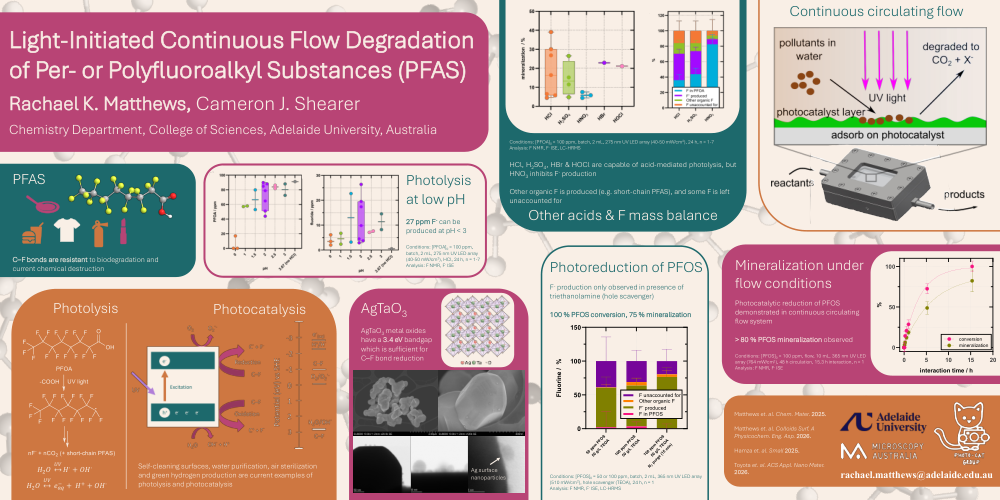
PFAS
C–F bonds are resistant to biodegradation and current chemical destruction
Photolysis
H_2 O ↔┴UV H^∙+〖OH〗^∙
H_2 O ↔┴UV e_aq^-+ H^++〖OH〗^∙
Photocatalysis
Self-cleaning surfaces, water purification, air sterilization and green hydrogen production are current examples of photolysis and photocatalysis
Photolysis at low pH
27 ppm F- can be produced at pH < 3
Conditions: [PFOA]0 = 100 ppm, batch, 2 mL, 275 nm UV LED array (40-50 mW/cm2), HCl, 24 h, n = 1-7
Analysis: F NMR, F- ISE
Other acids & F mass balance
Conditions: [PFOA]0 = 100 ppm, batch, 2 mL, 275 nm UV LED array (40-50 mW/cm2), 24 h, n = 1-7
Analysis: F NMR, F- ISE, LC-HRMS
HCl, H2SO4, HBr & HOCl are capable of acid-mediated photolysis, but HNO3 inhibits F- production
Other organic F is produced (e.g. short-chain PFAS), and some F is left unaccounted for
AgTaO3
AgTaO3 metal oxides have a 3.4 eV bandgap which is sufficient for C–F bond reduction
Photoreduction of PFOS
F- production only observed in presence of triethanolamine (hole scavenger)
100 % PFOS conversion, 75 % mineralization
Conditions: [PFOS]0 = 50 or 100 ppm, batch, 2 mL, 365 nm UV LED array (510 mW/cm2), hole scavenger (TEOA), 24 h, n = 1
Analysis: F NMR, F- ISE, LC-HRMS
Continuous circulating flow
Mineralization under flow conditions
Photocatalytic reduction of PFOS demonstrated in continuous circulating flow system
> 80 % PFOS mineralization observed
Conditions: [PFOS]0 = 100 ppm, flow, 10 mL, 365 nm UV LED array (764 mW/cm2), 48 h circulation, 15.3 h interaction, n = 1
Analysis: F NMR, F- ISE
Matthews et. al. Chem. Mater. 2025.
Matthews et. al. Colloids Surf. A Physicochem. Eng. Asp. 2026.
Hamza et. al. Small 2025.
Toyota et. al. ACS Appl. Nano Mater. 2026.