180 posters, 53 videos, 29 audios, 5 topics, 304 authors, 182 institutions
ePostersLive by SciGen Technologies S.A. All rights reserved.
7th Commonwealth Chemistry Posters
24-25 June, 2026 | Online

P106
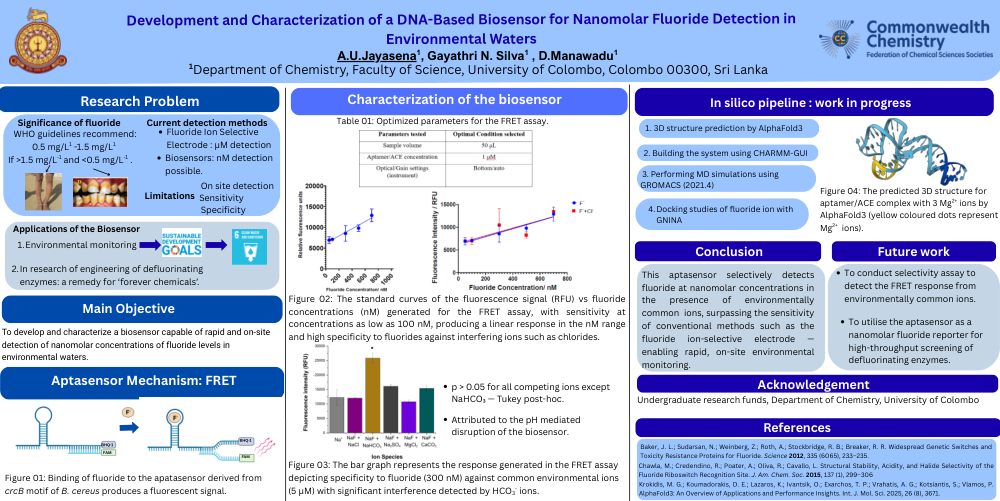
Development and characterization of a DNA-based biosensor for nanomolar fluoride detection in environmental waters.
Poster Presenter
Part of Topic
Clean Water and Sanitation (SDG 6)
Audio
Introduction & Research Problem Fluoride concentration in drinking water must be strictly regulated; WHO guidelines recommend maintaining levels between 0.5 mg/L and 1.5 mg/L to avoid health complications. While conventional monitoring tools like the Fluoride Ion-Selective Electrode are restricted to micromolar detection limits, biosensors offer a promising pathway for highly sensitive, nanomolar on-site detection. This study details the development and characterization of a rapid DNA-based FRET (Fluorescence Resonance Energy Transfer) biosensor optimized for environmental water monitoring and high-throughput screening of defluorinating enzymes.
Methodology & Optimization
The aptasensor is derived from the crcB fluoride riboswitch motif of Bacillus cereus. Binding of fluoride to the aptamer/ACE complex triggers a conformational shift that yields a measurable FRET signal using a FAM fluorophore. The assay parameters were optimized at a 50 μL sample volume, 1 μM aptamer/ACE concentration, and an automated bottom-read optical gain configuration.
Results & Characterization
The optimized FRET assay demonstrated a highly linear response across the nanomolar concentration range, achieving a sensitivity threshold as low as 100 nM. Specificity challenges were evaluated against common competing environmental ions (5 μM ) vs fluoride (300 nM). Using Tukey post-hoc multiple comparison analysis, no significant interference was observed (p > 0.05) for all ions except NaHCO3. A statistically significant signal shift was identified solely for NaHCO3, which is attributed to pH-mediated disruption of the integrity of the biosensor structure.
Computational Pipeline (In Silico Work-in-Progress)
To better understand the structural stability and halide selectivity of the recognition site, an in silico modeling pipeline is being executed. This workflow includes 3D biomolecular structure prediction of the aptamer/ACE complex paired with 3 Mg2+ ions via AlphaFold3, molecular system setup via CHARMM-GUI, molecular dynamics (MD) simulations via GROMACS (2021.4), and targeted ligand-ion docking utilizing GNINA.
Conclusion & Future Work
This DNA-based aptasensor successfully bypasses the sensitivity thresholds of classical analytical methods, enabling on-site nanomolar monitoring. Future objectives include expanding the selectivity matrix across broader environmental parameters and adapting the platform as a high-throughput reporter system to engineer defluorinating enzymes meant to target persistent fluorinated environmental contaminants.