180 posters, 53 videos, 29 audios, 5 topics, 304 authors, 182 institutions
ePostersLive by SciGen Technologies S.A. All rights reserved.
7th Commonwealth Chemistry Posters
24-25 June, 2026 | Online

P59
In silico antimicrobial potentials of amidoxime-based benzimidazole and benzimidamide derivatives
Part of Topic
Good Health and Wellbeing (SDG 3)
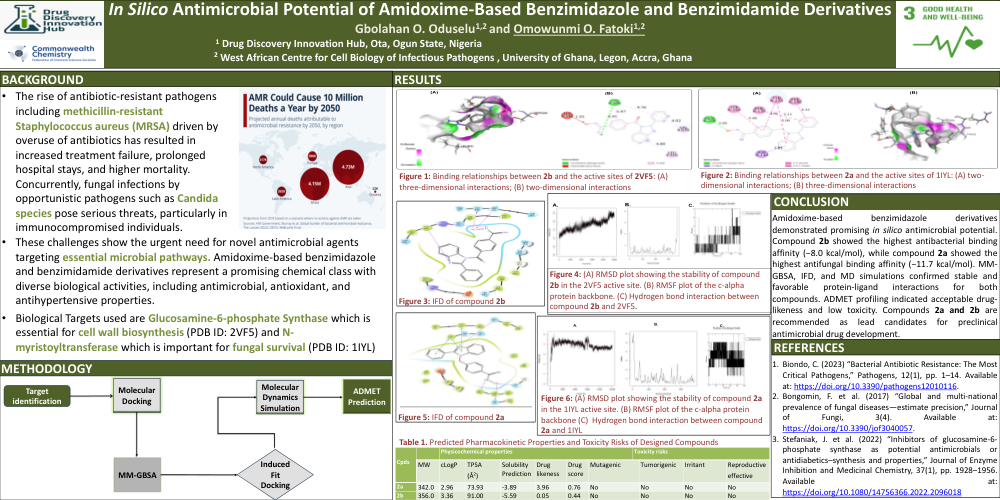
The rise of antibiotic-resistant pathogens, including “superbugs” such as methicillin-resistant Staphylococcus aureus (MRSA), has become a major health concern, driven by the overuse and misuse of antibiotics. This has resulted in increased treatment failure, prolonged hospital stays, and higher mortality rates. In addition, fungal infections caused by opportunistic pathogens such as Candida species continue to pose serious threats, particularly in immunocompromised individuals. These challenges emphasize the urgent need for the development of novel antimicrobial agents targeting essential microbial pathways. In this study, the in silico antimicrobial potential of amidoxime-based benzimidazole and benzimidamide derivatives was investigated against key bacterial and fungal targets. A structure-based drug design approach was employed to evaluate the binding affinity and stability of the synthesized compounds against glucosamine-6-phosphate synthase (GlmS) of Escherichia coli (PDB ID: 2VF5) and N-myristoyltransferase (NMT) of Candida albicans (PDB ID: 1IYL), critical for bacterial cell wall biosynthesis and fungal survival, respectively. Structure-based virtual screening approach was employed to evaluate the binding affinity and stability of the synthesized compounds. Molecular docking studies were performed to predict ligand-protein interactions and binding conformations within the active sites of the target enzymes. To further assess binding affinity and stability, MM-GBSA calculations, induced fit docking (IFD), and molecular dynamics (MD) simulations were conducted. Additionally, ADMET predictions were carried out to evaluate the pharmacokinetic and toxicity profiles of the compounds. The results showed that compound 2b (-8.0 kcal/mol) had the highest antibacterial binding affinity, compared to the reference drug gentamicin and the control ligand (-7.1 and -7.3 kcal/mol respectively), while compound 2a (-11.7 kcal/mol) had a better activity than the standard drug (-10.1 kcal/mol). MM-GBSA and IFD analyses confirmed favorable protein-ligand interactions. MD simulations indicated that 2b-2VF5 and 2a-1IYL complexes were relatively stable over the simulation period. ADMET profiling suggested optimal drug-likeness and low toxicity for most compounds, except for compound 4c, which showed potential tumorigenic risk. Overall, these findings highlight amidoxime-based benzimidazole derivatives, compounds 2a and 2b had the most promising antibacterial and antifungal activity.