253 posters, 14 videos, 27 audios, 14 topics, 392 authors, 132 institutions
ePostersLive by SciGen Technologies S.A. All rights reserved.
4th Commonwealth Chemistry Posters
October 4 - 5, 2023 | Online, United Kingdom

P31
Physicochemical and energetic properties of charcoals produced from residues of two tropical woods from Cameroon
Part of Topic
Affordable and clean energy
Physicochemical and energetic properties of charcoals produced from residues of two tropical woods from Cameroon
1. ABSTRACT
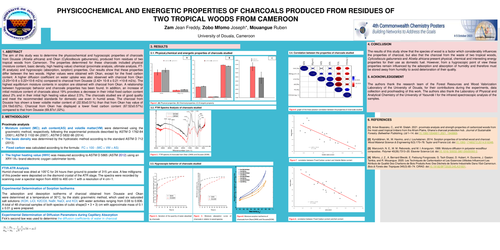
The aim of this study was to determine the physicochemical and hygroscopic properties of charcoals from Doussie (Afzelia africana) and Okan (Cylicodiscuis gabunensis), produced from residues of two tropical woods from Cameroon. The properties determined for these charcoals included physical (moisture content, basic density, high heating value) chemical (proximate analysis, ultimate analysis, FT-IR analysis) and hygroscopic (absorption, sorption) properties. Our results show that these properties differ between the two woods. Higher values were obtained with Okan, except for the fixed carbon content. A higher diffusion coefficient on water uptake was also observed with charcoal from Okan (3.25×10⁻⁸ ± 0.22×10⁻⁸ m2/s) compared to charcoal from Doussie (2.42× 10⁻⁸ ± 0.21 ×10⁻⁸ m2/s). The highest equilibrium moisture contents in sorption are obtained with charcoal from Okan. A relationship between hygroscopic behavior and charcoals properties has been found. In addition, an increase of initial moisture content of charcoals about 19% provokes a decrease in their initial fixed carbon content about 2% and in their initial high heating value about 2.5%. The charcoals studied are of good quality and meet the recommended standards for domestic use even in humid areas. The charcoal from Doussie has shown a lower volatile matter content of (22.93±0.51%) than that from Okan has value of (24.19±0.62%). Charcoal from Okan has displayed a lower fixed carbon content (67.52±0.57%) compared to that from Doussie (69,87±1,02%).
2. METHODOLOGY
Proximate analysis
FTIR-ATR Analysis
Humid charcoal was dried at 105°C for 24 hours then ground to powder of 315 μm size. A few milligrams of this powder were deposited on the diamond crystal of the ATR stage. The spectra were recorded by scanning over a spectral region from 4000 to 400 cm−1 with a resolution of 4 cm−1.
Experimental Determination of Sorption Isotherms
The adsorption and desorption isotherms of charcoal obtained from Doussie and Okan
were determined at a temperature of 30°C, by the static gravimetric method, which used six saturated salt solutions (KOH, LiCl, K2CO3, NaBr, NaCl, and KCl) with water activities ranging from 0.08 to 0.836. A total of 48 charcoal samples of both species of cubic shape(3 × 3 × 3) cm with approximate mass of 0.1 ± 0.01 g were prepared.
Experimental Determination of Diffusion Parameters during Capillary Absorption
Fick’s second law was used to determine the diffusion coefficients of water in charcoal
3. RESULTS
3.1-Physical, chemical and energetic properties of charcoals studied
3.2-FTIR spectra analysis of charcoal studied
3.2-Hygroscopic behavior of charcoal studied
3.3-Correlation between the properties of charcoals studied
4. CONCLUSION
The results of this study show that the species of wood is a factor which considerably influences the properties of charcoal, but also that the charcoal from the waste of two tropical woods, Cylicodiscuis gabunensis and Afzelia africana present physical, chemical and interesting energy properties for their use as domestic fuel. However, from a hygroscopic point of view these properties remain influenced by the adsorption and absorption of humidity and therefore must be stored away from humidity to avoid deterioration of their quality.
5. REFERENCES
[1] Antwi-Boasiako, C., and M. Glalah. 2021. proximate analysis and strength properties of carbonized woods from the most-used tropical timbers from the Afram Plains, Ghana’s charcoal production hub. Journal of Sustainable Forestry. Bellwether Publishing, Ltd 1–14. doi:10.1080/10549811.2021. 1948869.
[2] Kymäläinen, M., M. Havimo, and J. Louhelainen. 2014. Sorption properties of torrefied wood and charcoal. Wood Material Science & Engineering 9(3):170–78. Taylor and Francis Ltd. doi:10.1080/ 17480272.2014.916348.
[3] Marcovich, N. E., M. M. Reboredo, and M. I. Aranguren. 1999. Moisture diffusion in polyester-woodflour composites. Polymer 40(26):7313–20. Elsevier Science Ltd. doi:10.1016/ S0032-3861(99)00093-2.
[4] Mfomo, J. Z., A. Bernard Biwolé, E. Fedoung Fongzossie, G. Tsoh Ekassi, D. Hubert, H. Ducenne, J. Gaston Tamba, and R. Mouangue. 2020. Les Techniques de Carbonisation et Les Essences Utilisées Influencent Les Attributs de Qualité Des Charbons de Bois Produits Avec Des Déchets de Scierie Industrielle Dans l’Est-Cameroun. Bois & Forets des Tropiques 345(3):65–74. CIRAD. doi:10.19182/BFT2020.345.A31831.