253 posters, 14 videos, 27 audios, 14 topics, 392 authors, 132 institutions
ePostersLive by SciGen Technologies S.A. All rights reserved.
4th Commonwealth Chemistry Posters
October 4 - 5, 2023 | Online, United Kingdom

P03
In situ and facile green synthesis of gold-reduced graphene oxide using betel leaf extract for catalytic reduction of 4-nitrophenol.
Poster Presenter
Part of Topic
Affordable and clean energy
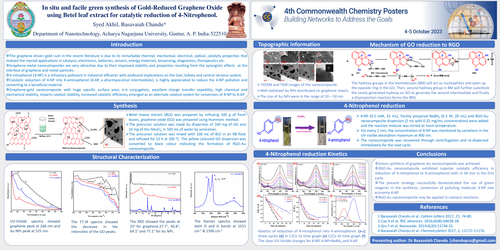
In situ and facile green synthesis of Gold-Reduced Graphene Oxide using Betel leaf extract for catalytic reduction of 4-Nitrophenol.
Syed Akhil,1 Basavaiah Chandu*1
1 Department of Nanotechnology, Acharya Nagarjuna University, Guntur, A. P.-522510 *Corresponding author email: chandupcu@gmail.com
The current work reports an environmentally friendly, novel and facile synthesis of gold-reduced graphene oxide (Au-RGO) nanocomposite using Betel leaf extract as a versatile reducing and stabilizing agent and its catalytic properties has been explored for the reduction of 4-nitrophenol. The phytochemical (hydroxyl groups) contents in the leaf extract are liable for the reduction of gold and graphene oxide (GO). The subsequent Au-RGO nanocomposite is characterized by UV-Visible spectroscopy, infrared spectroscopy and Raman spectroscopy which confirmed the formation of RGO from GO. Its structural properties are further investigated using powder X-ray diffraction, field emission scanning electron microscopy and transmission electron microscopy to contemplate the size and morphological information. The Au-RGO nanocomposite contained about 10 wt% of Au and the Au-nanoparticles are enlivened on the surface of the reduced graphene oxide sheet with average diameter size of 25±1.2 nm. The resultant Au-RGO nanocomposite exhibited a decent catalytic activity in the reduction of 4-Nitrophenol (4NP) to 4- aminophenol (4AP) by NaBH4 which was demonstrated at an ambient condition. Therefore, a green chemistry protocol was successfully developed for cost-effective synthesis of Au-RGO nanocomposite which converted a polluting molecule, 4NP into a useful molecule 4AP, thus reducing the industrial pollution and converting it into industrially useful molecule.