Loading...

253 posters, 14 videos, 27 audios, 14 topics, 392 authors, 132 institutions

ePostersLive by SciGen Technologies S.A. All rights reserved.

4th Commonwealth Chemistry Posters

October 4 - 5, 2023 | Online, United Kingdom

4th Commonwealth Chemistry Posters banner

P28

Carbon-Based Catalyst for Green Hydrogen Production and Simultaneous Organic Transformation: Towards Sustainable Energy Access
Part of Topic

Affordable and clean energy

Title: Carbon-Based Catalyst for Green Hydrogen Production and Simultaneous Organic Transformation: Towards Sustainable Energy Access

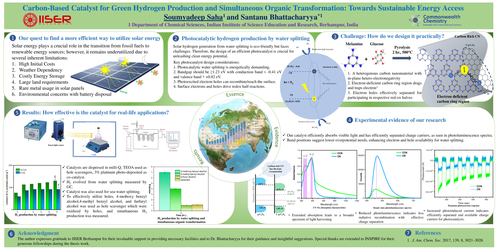
A. Our quest to find a more efficient way to utilize solar energy

Solar energy plays a crucial role in the transition from fossil fuels to renewable energy sources; however, it remains underutilized due to several inherent limitations:

1.High Initial Costs
2.Weather Dependency
3.Costly Energy Storage
4.Large land requirements
5.Rare metal usage in solar panels
6.Environmental concerns with battery disposal
 
B. Photocatalytic hydrogen production by water splitting

Solar hydrogen generation from water splitting is eco-friendly but faces challenges. Therefore, the design of an efficient photocatalyst is crucial for unleashing clean energy potential.

Key photocatalyst design considerations:

1. Photocatalytic water splitting is energetically demanding.
2. Bandgap should be ≥1.23 eV with conduction band < -0.41 eV and valence band > +0.82 eV.
3. Photoexcited electron holes can recombine/reach the surface.
4. Surface electrons and holes drive redox half-reactions.

C. Challenge: How do we design it practically?

1. A heterogenous carbon nanomaterial with in-plane hetero-electronegativity

2. Electron-deficient carbon ring region drags and traps electron1

3. Electron holes effectively separated for participating in respective red-ox halves

D. Experimental evidence of our research

1. Our catalyst efficiently absorbs visible light and has efficiently separated charge carriers, as seen in photoluminescence spectra.
2. Band positions suggest lower overpotential needs, enhancing electron and hole availability for water splitting.

E. Results: How effective is the catalyst for real-life applications?

1. Catalysts are dispersed in milli-Q, TEOA used as hole scavengers, 3% platinum photo-deposited as co-catalyst.
2. H2 evolved from water splitting measured by GC.
3. Catalyst was also used for sea-water splitting.
4. To effectively utilize holes, 4-methoxy benzyl alcohol,4-methyl benzyl alcohol, and furfuryl alcohol was used as hole scavenger which were oxidized by holes, and simultaneous H2 production was measured.
4th Commonwealth Chemistry Posters » banner
Copyright © 2015-2026, ePostersLive® SciGen is a registered trademark of SciGen Technologies S.A. Patent pending.

This website and third-party tools we use rely on cookies for the best user experience. By selecting "I agree", you agree to cookie usage as described in our Privacy Policy.