253 posters, 14 videos, 27 audios, 14 topics, 392 authors, 132 institutions
ePostersLive by SciGen Technologies S.A. All rights reserved.
4th Commonwealth Chemistry Posters
October 4 - 5, 2023 | Online, United Kingdom

P26
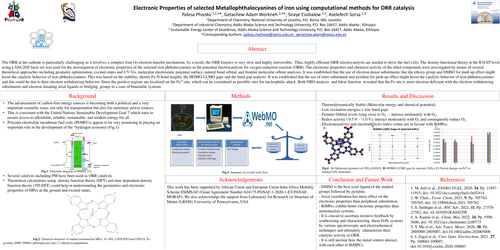
Electronic Properties of selected Metallophthalocyanines of iron using computational methods for ORR catalysis
Poster Presenter
Part of Topic
Affordable and clean energy
Audio
Electronic Properties of selected Metallophthalocyanines of iron using computational methods for ORR catalysis
PalesaPhooko1,2,3*, GetachewAdam Workneh2,3*, SirayeEsubalew2,3, AselefechSorsa2,3
1Department of Chemistry, National University of Lesotho, P.O. Roma 180, Lesotho
2Department of industrial Chemistry, Addis Ababa Science and Technology University, P.O. Box 16417, Addis Ababa , Ethiopia
3Sustainable Energy Center of Excellence, Addis Ababa Science and Technology University, P.O. Box 16417, Addis Ababa, Ethiopia
*Corresponding Authors: palesa.mathese@aastu.edu.et, getachew.adam@aastu.edu.et
The ORR at the cathode is particularly challenging as it involves a complex four (4) electron transfer mechanism. As a result, the ORR kinetics is very slow and highly irreversible. Thus, highly efficient ORR electrocatalysts are needed to drive the fuel cells. The density functional theory at the B3LYP level using LANL2DZ basis set was used for the investigation of electronic properties of the selected iron phthalocyanines as the potential electrocatalysts for oxygen reduction reaction (ORR). The electronic properties and chemical activity of the titled compounds were investigated by means of several theoretical approaches including geometry optimization, excited states and UV-Vis, molecular electrostatic potential surface, natural bond orbital, and frontier molecular orbital analyses. It was established that the use of electron donor substituents like the ethoxy group and DMSO for push up effect might boost the catalytic behavior of iron phthalocyanines. This was based on the stability, shorter Fe-N bond lengths, the HOMO-LUMO gaps and the band gap analysis. It was established that the use of nitro substituent and pyridine for push up effect might boost the catalytic behavior of iron phthalocyanines and this could be due to their electron withdrawing behavior. Since the positive regions are localized on the Fe2+ site, which can be considered as possible sites for nucleophilic attack. Both NBO analysis and fukui function revealed that the Fe site is more electron deficient with the electron withdrawing substituents and electron donating axial ligands or bridging groups in a case of bimetallic systems.