253 posters, 14 videos, 27 audios, 14 topics, 392 authors, 132 institutions
ePostersLive by SciGen Technologies S.A. All rights reserved.
4th Commonwealth Chemistry Posters
October 4 - 5, 2023 | Online, United Kingdom

P252
Evaluation of alginate-modified starch composite as shell material to encapsulate bacteria for the prevention of D. cymosum poisoning in ruminants
Poster Presenter
Authors
Part of Topic
Industry, innovation and infrastructure
Evaluation of alginate-modified starch composite as shell material encapsulating bacteria for the prevention of D. cymosum poisoning in ruminants
Tjaronda Karumendu1, Percy Chimwamurombe1and Habauka M. Kwaambwa1
1 Department Biology, Chemistry and Physics, School of Natural and Applied Sciences, Namibia University of Science and Technology, Namibia
ABSTRACT
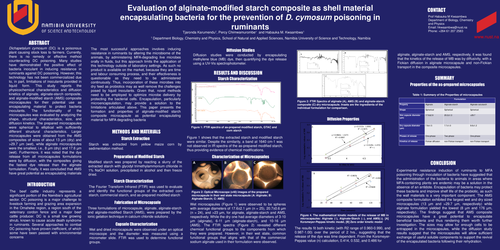
Dichapetalum cymosum (DC) is a poisonous plant causing stock loss to farmers. Currently, there is no remedy or effective method counteracting DC poisoning. Many studies have demonstrated the positive effect of bacteria inoculant in inducing resistance in ruminants against DC poisoning. However, this technology has not been commercialized due to, in part, limitations of inoculants provided in liquid form. This study reports the physicochemical characteristics and diffusion kinetics of alginate, alginate-starch composite, and alginate-modified starch (AMS) composite microcapsules for their potential use as encapsulating material to protect bacteria inoculants. The functionality of the microcapsules was evaluated by analyzing the shape, structural characteristics, size, and diffusion kinetics. The prepared microcapsules were spherical to elliptical with sufficiently different structural characteristics. Larger microcapsules were obtained from the AMS composites of sizes of about 13 μm (dry) and >29.7 μm (wet), while alginate microcapsules were the smallest, i.e., 8 μm (dry) and 17.6 μm (wet). Furthermore, it was noted that the dye release from all microcapsules formulations were by diffusion, with the composites giving the fastest dye release than the alginate formulation. Finally, it was concluded that AMS have great potential as encapsulating materials.
INTRODUCTION
The beef cattle industry represents a significant portion of the Namibia’s agricultural sector. DC poisoning is a major challenge to livestock farming and grazing area expansion in the Omaheke region, a region south of the veterinary cordon fence and a major beef cattle producer. DC is a small low growing shrub, known to cause acute death syndrome in ruminants. Several approaches to combat DC poisoning have proven inefficient, of which some have been passed with environmental concerns. The most successful approaches involves inducing resistance in ruminants by altering the microbiome of the animals, by administering MFA-degrading live microbes orally in fluids, but this approach limits the application of this technology outside of laboratory settings. As such no product is available on the market, because they are time and labour consuming process, and their effectiveness is questionable as they need to be administered continuously. Thus, incorporation of these microbes into dry feed as probiotics may as well remove the challenges posed by liquid inoculants. Given that, novel methods need to be employed to optimize microbe delivery by protecting the bacterial cells. Encapsulation, particularly microencapsulation, may provide a solution to the limitations articulated above. This paper presents the formation and properties of alginate-modified starch composite microcapsule as potential encapsulating material for MFA degrading bacteria
METHODS AND MATERIALS
Starch Extraction
Starch was extracted from yellow maize corn by sedimentation method.
Preparation of Modified Starch
Modified starch was prepared by reacting a slurry of the extracted starch with glycidyl trimethylammonium chloride in 1% NaOH solution, precipitated in alcohol and then freeze dried.
Starch Characterization
The Fourier Transform Infrared (FTIR) was used to evaluate and identify the functional groups of the extracted corn starch, commercial starch, and as-prepared modified starch
Fabrication of Microcapsule
Three formulations of microcapsule, alginate, alginate-starch and alginate-modified Starch (AMS), were prepared by the ionic gelation technique in calcium chloride solutions .
Capsule Characterization
Wet and dried microcapsule were observed under an optical microscope and the diameter was measured using a micrometer slide. FTIR was used to determine functional groups.
Diffusion Studies
Diffusion studies were conducted by encapsulating methylene blue (MB) dye, then quantifying the dye release using a UV-Vis spectrophotometer.
RESULTS AND DISCUSSION
Starch Characterization
Figure 1 shows that the extracted starch and modified starch were similar. Despite the similarity, a band at 1640 cm-1 was not observed in IR spectra of the as-prepared modified starch, thus providing evidence of chemical modifications.
Characterization of Microcapsules
Wet microcapsules (Figure 1) were observed to be spheres with average diameters of 17.6±2.1 μm (n = 25), 20.7±0.6 μm (n = 24), and >23 μm, for alginate, alginate-starch and AMS, respectively. While the dry one had average diameters of 3-10 μm (alginate), 6-11 μm (alginate-starch), and 10-16 μm (AMS). The FTIR spectra (Figure 2) revealed different chemical functional groups to the components from which they were prepared. However, in their wet state, common functional groups that aligns with that of the commercial sodium alginate used in their formulation were observed.
Diffusion Properties
The results fit both kinetic (with R2 range of 0.960-0.990, and 0.987-1.00) over the period of 2 hrs., suggesting that the release of the dye was time dependent. From the Korsmeyer-Peppas value (n) calculation, 0.414, 0.532, and 0.486 for alginate, alginate-starch and AMS, respectively, it was found that the kinetics of the release of MB was by diffusivity, with a Fickian diffusion in alginate microcapsule and non-Fickian transport in the composite microcapsules.
SUMMARY
Properties of the as-prepared microcapsules
CONCLUSION
Experimental resistance induction of ruminants to MFA poisoning through inoculation of bacteria have suggested that the administration of the bacteria to animals in areas where MFA-containing plants are endemic may be a solution in the absence of an antidote. Encapsulation of bacteria may protect these bacteria and improve shelf life of the probiotic, as such the wall materials is a very important component. The AMS composite formulation exhibited the largest wet and dry sized microcapsules (13 μm and >29.7 μm, respectively) while alginate formulation yielded the lowest (8 μm and 176 μm, respectively). The findings suggest that AMS composite microcapsules have a great potential to encapsulate beneficial bacteria and thus rendering them worth further investigation. The sizes may allow for enough cells to be entrapped in the microcapsules, while the diffusion study results suggest that the microcapsules will allow sufficient exchange of useful soluble components to support the revival of the encapsulated bacteria following their rehydration