253 posters, 14 videos, 27 audios, 14 topics, 392 authors, 132 institutions
ePostersLive by SciGen Technologies S.A. All rights reserved.
4th Commonwealth Chemistry Posters
October 4 - 5, 2023 | Online, United Kingdom

P247
Development of jam from watermelon peels (Citrullus lanatus), with the inclusion of moringa powder (Moringa oleífera).
Poster Presenter
Authors
Part of Topic
Zero hunger
Abstract
The growing concern to minimize food waste and the interest in adding more and more nutritional value to food products make it extremely important to find new ways of reusing waste from food processing or preparation. The aim of this study was to develop jams from watermelon (Citrusllus lanattus) peel with the inclusion of Moringa oleifera powder. Four formulations were prepared with different levels of moringa inclusion (F0 with 0% moringa), (F1 with 1.5% moringa), (F2 with 2.5% moringa), (F3 with 3% moringa) and (F4 with 5% moringa). A preliminary sensory analysis was carried out, in which formulations F1 and F2 were more acceptable to the tasters (using the affective test). The formulations chosen by the tasters were then reproduced together with the standard F0 formulation and characterized. Physico-chemical analysis (titratable acidity, pH, soluble solids) and sensory analysis were carried out. The watermelon rind jam with moringa inclusion showed average values of: 0.9% titratable acidity, pH=3.8, and 66.6ºBrix soluble solids. From the three jam formulations, F1 had the highest sensory acceptance by the tasters, with an acceptance rate of 87.6%, and 62.5% of the tasters said they would buy the product. Based on the values obtained for the parameters acidity, pH and soluble solids, and despite the fact that the values were a little higher than recommended, it was clear that they did not affect the physical and chemical quality of the jam, as shown by the results of the sensory analysis, which were satisfactory. The production of jam is an alternative way of using fruit that has not reached the standard of classification, that has passed the ripeness stage, it is a way of preserving and diversifying fruit-based products, allowing the consumption of a product based on that fruit during periods of scarcity. In addition to making use of parts of fruit that are generally considered unfit for consumption and in turn discarded as waste. The use of fruit in its entirety helps to reduce post-harvest losses and promotes the production of various products.
Introduction
The lack of knowledge on the part of consumers about the advantages of consuming and including non-conventional parts of the diet results in the nutrients being discarded and poorly utilized.
Watermelon peel is a by-product with high levels of minerals, proteins, dietary fiber, bioactive compounds, phenolic and amino acids that can help reduce the prevalence of degenerative diseases. They can be used to process various products such as syrups, candied fruit, jams, juices and flour production, with a nutritional focus on mineral and fibre content. Fruit jam is an acceptable by-product for consumers, but on its own it doesn't meet all nutritional needs to the point of helping to combat food and nutritional insecurity.
Moringa oleifera has a high potential for essential nutrients, antioxidants and photochemical compounds. Its inclusion in peel jam could add value with a high nutritional content. The aim of this research is to develop jam from watermelon peels (Citullus lanatus) with the inclusion of moringa powder (Moringa oleífera).
Methods and Materials
The samples were obtained from the informal market. One watermelon weighted around 4.5kg
F0: watermelon rind and 0% moringa powder
F1: watermelon rind and 1.5% moringa powder
F2: watermelon rind and 2.5% moringa powder
For all formulation were used 500g of watermelon ring, 500g of sugar, pectin and Citric acid
Results
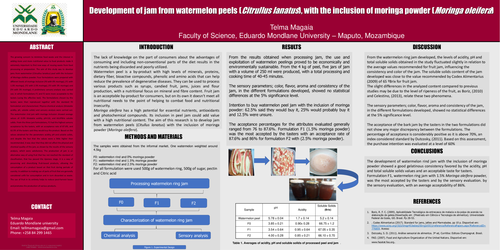
From the results obtained when processing jam, the use and exploitation of watermelon peelings proved to be economically and environmentally sustainable. From the 4 kg of peel, five jars of jam with a volume of 250 ml were produced, with a total processing and cooking time of 40-45 minutes.
The sensory parameters; color, flavor, aroma and consistency of the jam, in the different formulations developed, showed no statistical differences at the 5% significance level.
Intention to buy watermelon peel jam with the inclusion of moringa powder: 62.5% said they would buy it, 25% would probably buy it and 12.5% were unsure.
The acceptance percentages for the attributes evaluated generally ranged from 76 to 87.6%. Formulation F1 (1.5% moringa powder) was the most accepted by the tasters with an acceptance rate of 87.6% and 86% for formulation F2 with (2.5% moringa powder).
Discussion
From the watermelon ring jam developed, the levels of acidity, pH and total soluble solids obtained in the study fluctuated slightly in relation to the average values recommended for fruit jam, influencing the consistency and color of the jam. The soluble solids content of the jam developed was close to the value recommended by Codex Alimentarius (2009) of 65 ºBrix for fruit jam.
The slight differences in the analyzed content compared to previous studies may be due to the level of ripeness of the fruit, as Boriz, (2010) and Celestino, (2013), relate these two phenomena.
The sensory parameters; color, flavor, aroma and consistency of the jam, in the different formulations developed, showed no statistical differences at the 5% significance level.
The acceptance of the bark jam by the tasters in the two formulations did not show any major discrepancy between the formulations. The percentage of acceptance is considerably positive as it is above 70%, an index considered standard by Dutcosky, (2011). Based on this assessment, the purchase intention was evaluated at a level of 60%.
Conclusions
The development of watermelon rind jam with the inclusion of moringa powder showed a good gelatinous consistency favored by the acidity, pH and total soluble solids values and an acceptable taste for tasters.
Formulation F1, watermelon ring jam with 1.5% Moringa oleifera powder, was the most accepted by the tasters and by the sensory evaluation. by the sensory evaluation, with an average acceptability of 86%.