253 posters, 14 videos, 27 audios, 14 topics, 392 authors, 132 institutions
ePostersLive by SciGen Technologies S.A. All rights reserved.
4th Commonwealth Chemistry Posters
October 4 - 5, 2023 | Online, United Kingdom

P241
Magnesium, zinc, and copper nutrient nanoparticles infused sodium alginate-carboxymethyl cellulose-based nano-hybrids as an efficient slow-release fertilizer
Poster Presenter
Authors
Part of Topic
Zero hunger
Magnesium, zinc, and copper nutrient nanoparticles infused sodium alginate-carboxymethyl cellulose-based nano-hybrids as an efficient slow-release fertilizer
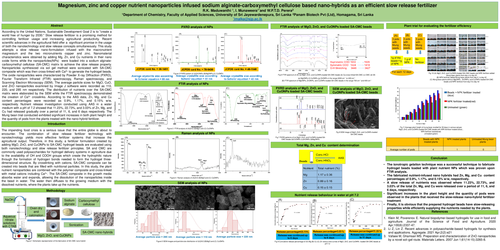
According to the United Nations, Sustainable Development Goal 2 is to "create a world free of hunger by 2030." Slow-release fertilizer is a promising method for controlling fertilizer usage and increasing agricultural productivity. Recent scientific advances in the agricultural field offer a significant promise in the usage of both the nanotechnology and slow-release concepts simultaneously. This study attempts a slow-release nano-formulation infused with the macronutrient magnesium and the two micronutrients copper and zinc. Nanomaterial characteristics were obtained by adding Mg, Zn, and Cu nutrients in their nano oxide forms while the nanoparticles(NPs) were loaded into a sodium alginate-carboxymethyl cellulose (SA-CMC) matrix to achieve the slow-release property. Nanoparticles synthesized via sol-gel method were sonicated with SA-CMC composite which was then cross-linked with Ca2+ to generate the hydrogel beads. The oxide nanoparticles were characterized by Powder X-ray Diffraction (PXRD), Fourier Transform Infrared (FTIR) spectroscopy, Raman spectroscopy, and Scanning Electron Microscopy (SEM). The average particle sizes for MgO, CuO, and ZnO nanoparticles examined by Image J software were recorded as 110, 220, and 285 nm respectively. The distribution of nutrients over the SA-CMC matrix were elaborated by the SEM while the FTIR spectroscopy demonstrated the creation of Ca2+ crosslinks. According to the AAS data, Zn, Mg, and Cu content percentages were recorded as 0.9%, 1.17%, and 0.15% w/w, respectively. Nutrient release investigation conducted using AAS in a water medium with a pH of 7.2 showed that 11.23%, 22.73%, and 3.03% of Zn, Mg, and Cu had released gradually over a period of 11, 6, and 6 days respectively. The Mung bean trial conducted exhibited significant increases in both plant height and the quantity of pods from the plants treated with the nano-hybrid fertilizer.
The impending food crisis is a serious issue that the entire globe is about to encounter. The combination of slow-release fertilizer technology with nanotechnology yields more effective fertilizer systems that increase agricultural output. Therefore, in this study, a fertilizer formulation created by adding MgO, ZnO, and CuONPs to SA-CMC hydrogel beads are evaluated using both nanotechnology and slow-release fertilizer principles. SA and CMC are commonly used polysaccharides for hydrogel delivery systems in agriculture due to the availability of OH and COOH groups which create the hydrophilic nature through the formation of hydrogen bonds needed to form the hydrogel three-dimensional structure. By crosslinking with cations, SA-CMC composite can be created into beads that are filled with nutritional particles. In this study, the plant nutrient nanoparticles are combined with the polymer composite and cross-linked with metal cations including Ca2+. The SA-CMC composite in the growth media absorbs water and expands, allowing the dissolution of the nanoparticles inside the bead in water. The water then diffuses to the growing medium with the dissolved nutrients, where the plants take up the nutrients.