253 posters, 14 videos, 27 audios, 14 topics, 392 authors, 132 institutions
ePostersLive by SciGen Technologies S.A. All rights reserved.
4th Commonwealth Chemistry Posters
October 4 - 5, 2023 | Online, United Kingdom

P245
Visible light active photocatalytic cellulose acetate/Co-ZnO nanofiber membranes for active food packaging
Part of Topic
Zero hunger
Visible light active photocatalytic cellulose acetate/Co-ZnO nanofiber membranes for active food packaging
S. D. Deshapriya1, Dr. I. Munaweera*1
1 Department of Chemistry, Faculty of Applied Sciences, University of Sri Jayewardenepura, Gangodawila, Nugegoda, Sri Lanka.
* Corresponding author: imalka@sjp.ac.lk
Introduction and objectives
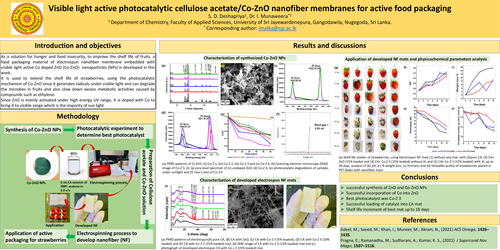
As a solution for hunger and food insecurity, to improve the shelf life of fruits, a food packaging material of electrospun nanofiber membrane embedded with visible light active Co doped ZnO (Co-ZnO) nanoparticles (NPs) is developed in this work.
It is used to extend the shelf life of strawberries, using the photocatalytic mechanism of Co-ZnO since it generates radicals under visible light and can degrade the microbes in fruits and also slow down excess metabolic activities caused by compounds such as ethylene.
Since ZnO is mainly activated under high energy UV range, it is doped with Co to bring it to visible range which is the majority of sun light.
Methodology
Synthesis of Co-ZnO NPs - Photocatalytic experiment to determine best photocatalyst - Preparation of Cellulose acetate and Co-ZnO solution -
Electrospinning process to develop nanofiber (NF) - Application of active packaging for strawberries
Results and discussions
Characterization of synthesized Co-ZnO NPs
(a) PXRD patterns of (i) ZnO, (ii) Co-Z 1, (iii) Co-Z 2, (iv) Co-Z 3 and (v) Co-Z 4, (b) Scanning electron microscope (SEM) image of Co-Z 3, Zn 2p core-level spectrum of (c) undoped ZnO, (d) Co-Z 4, (e) photocatalytic degradation of samples under sunlight and (f) Tauc’s plot of Co-Z 3
Characterization of developed electrospun NF mats
(a) PXRD patterns of electrospun(A) pure CA, (B) CA with ZnO, (C) CA with Co-Z 3 (5% loaded), (D) CA with Co-Z 3 (10% loaded) and (E) CA with Co-Z 3 (15% loaded) mat, (b) SEM image of CA with Co-Z 3 (15% loaded) mat and (c) photograph of developed electrospun CA with Co-z 3 (15% loaded) mat
Application of developed NF mats and physicochemical parameters analysis
(a) Shelf life studies of strawberries, using electrospun NF mats (1) without any mat, with (2)pure CA, (3) CA+ ZnO (15% loaded and (4) CA+ Co-Z 3 (15% loaded) without VL and (5) CA+ Co-Z 3 (15% loaded) with VL up to 18 days, analysis of (b) pH, (c) % weight loss, (c) firmness and (d) titratable acidity of strawberries placed in PET boxes with nanofiber mats.
Conclusions
References
Adeel, M.; Saeed, M.; Khan, I.; Muneer, M.; Akram, N., (2021) ACS Omega, 1426–1435.
Pragna, E.; Ramanadha, M.; Sudharani, A.; Kumar, K. S., (2021) J Supercond Nov Magn, 1507–1516.