253 posters, 14 videos, 27 audios, 14 topics, 392 authors, 132 institutions
ePostersLive by SciGen Technologies S.A. All rights reserved.
4th Commonwealth Chemistry Posters
October 4 - 5, 2023 | Online, United Kingdom

P244
Interfacial rheology of plant proteins
Poster Presenter
Authors
Part of Topic
Zero hunger
Hypothesis
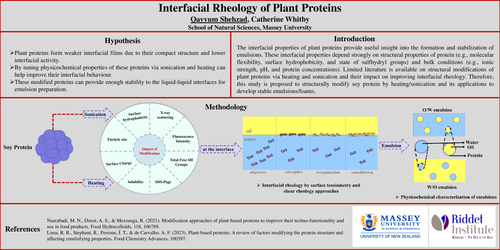
Plant proteins form weaker interfacial films due to their compact structure and lower interfacial activity By tuning physicochemical properties of these proteins vi a sonication and heating can help improve their interfacial behaviour These modified proteins can provide enough stability to the liquid liquid interfaces for emulsion preparation
Introduction
The interfacial properties of plant proteins provide useful insight into the formation and stabilization of emulsions These interfacial properties depend strongly on structural properties of protein (e g molecular flexibility, surface hydrophobicity, and state of sulfhydryl groups) and bulk conditions (e g ionic strength, pH, and protein concentrations) Limited literature is available on s tructural modifications of plant proteins via heating and sonication and their impact on improving interfacial rheology Therefore, this study is proposed to structurally modify soy protein by heating/sonication and its applications to develop stable emulsions/foams.
References
Nasrabadi, M. N., Doost , A. S., & Mezzenga , R. (2021). Modification approaches of plant based proteins to improve their techno functionality and use in food products. Food Hydrocolloids, 118, 106789.
Lima, R. R., Stephani, R., Perrone, Í. T., & de Carvalho, A. F. (2023). Plant based proteins: A review of factors modifying the protein structure and affecting emulsifying properties. Food Chemistry Advances, 100397.