253 posters, 14 videos, 27 audios, 14 topics, 392 authors, 132 institutions
ePostersLive by SciGen Technologies S.A. All rights reserved.
4th Commonwealth Chemistry Posters
October 4 - 5, 2023 | Online, United Kingdom

P237
Aqueous Microwave Assisted Novel Synthesis of Isothiocyanates by Amine Catalysed Thionation of Isocyanides with Lawesson’s Reagent
Poster Presenter
Authors
Part of Topic
Sustainable cities and communities
Aqueous Microwave Assisted Novel Synthesis of Isothiocyanates by Amine Catalysed Thionation of Isocyanides with Lawesson’s Reagent
Sodeeq Aderotimi Salami*, Vincent J. Smith, Rui W.M. Krause
Rhodes University, Grahamstown, Makhanda, 6139 South Africa.
INTRODUCTION
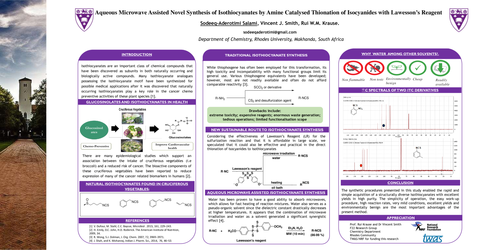
Isothiocyanates are an important class of chemical compounds that have been discovered as subunits in both naturally occurring and biologically active compounds. Many isothiocyanate analogues possessing the isothiocyanate motif have been synthesized for possible medical applications after it was discovered that naturally occurring isothiocyanates play a key role in the cancer chemopreventive activities of these plant species [1].
There are many epidemiological studies that support an association between the intake of cruciferous vegetables (i.e., broccoli) and a reduced risk of cancer. The bioactive components of these cruciferous vegetables have been reported to reduce the expression of many cancer-related biomarkers in humans [2].
TRADITIONAL ISOTHIOCYANATE SYNTHESIS
While thiophosgene has often been employed for this transformation, its high toxicity and incompatibility with many functional groups limit its general use. Various thiophosgene equivalents have been developed; however, most are not readily available and often do not afford comparable reactivity [3].
NEW SUSTAINABLE ROUTE TO ISOTHIOCYANATE SYNTHESIS
Considering the effectiveness of Lawesson’s Reagent (LR) for the sulfurization reaction and that it is affordable on a large scale, we speculated that it could also be effective and practical in the direct thionation of isocyanides to isothiocyanates
AQUEOUS MICROWAVE-ASSISTED ISOTHIOCYANATE SYNTHESIS
Water has been proven to have a good ability to absorb microwaves, which allows for fast heating of reaction mixtures. Water also serves as a pseudo-organic solvent since the dielectric constant drastically decreases at higher temperatures. It appears that the combination of microwave irradiation and water as a solvent generated a significant synergistic effect [4].
CONCLUSION
The synthetic procedures presented in this study enabled the rapid and simple acquisition of structurally diverse isothiocyanates with excellent yields in high purity. The simplicity of operation, the easy work-up procedure, high reaction rates, very mild conditions, excellent yields, and environmentally benign are the most important advantages of the present method.