253 posters, 14 videos, 27 audios, 14 topics, 392 authors, 132 institutions
ePostersLive by SciGen Technologies S.A. All rights reserved.
4th Commonwealth Chemistry Posters
October 4 - 5, 2023 | Online, United Kingdom

P20
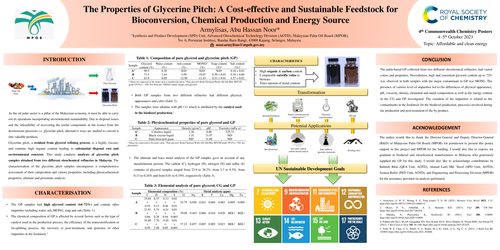
The properties of glycerine pitch: a cost-effective and sustainable feedstock for bioconversion, chemical production and energy source
Poster Presenter
Authors
Part of Topic
Affordable and clean energy
The Properties of Glycerine Pitch: A Cost-effective and Sustainable Feedstock for Bioconversion, Chemical Production and Energy Source
Armylisas, Abu Hassan Noor*
*Synthesis and Product Development (SPD) Unit, Advanced Oleochemical Technology Division (AOTD), Malaysian Palm Oil Board (MPOB),
No. 6, Persiaran Institusi, Bandar Baru Bangi, 43000 Kajang, Selangor, Malaysia.
noor.armylisas@mpob.gov.my
INTRODUCTION
As the oil palm sector is a pillar of the Malaysian economy, it must be able to carry out its operations incorporating environmental sustainability. Due to disposal issues and the infeasibility of recovering the useful components in the wastes from the downstream processes i.e. glycerine pitch, alternative ways are studied to convert it into valuable products.
Glycerine pitch, a residual from glycerol refining process, is a highly viscous, and contains high organic content leading to substantial disposal cost and environmental concerns. This study conducts analyses of glycerine pitch samples obtained from two different oleochemical refineries in Malaysia. The characterisation of the glycerine pitch samples encompasses a comprehensive assessment of their composition and various properties, including physicochemical properties, ultimate and proximate analysis.
CHARACTERISATION
The palm-based GP collected from two different oleochemical refineries, had varied colors and properties. Nevertheless, high and consistent glycerol content up to 72% was observed in both samples with the major contaminant in GP was MONG. The presence of various level of impurities led to the differences of physical appearance, pH, viscosity, density, elemental and metal composition as well as the energy content in the CG and GP investigated. The variation of the impurities is related to the contaminants in the feedstock for the biodiesel production, processes involved during the production and post-treatment of the by-product.
ACKNOWLEDGEMENT
The author would like to thank the Director-General and Deputy Director-General (R&D) of Malaysian Palm Oil Board (MPOB) for permission to present this poster, support in this project and MPOB for the funding. I would also like to express my gratitude to biodiesel and oleochemical manufacturers in Malaysia who generously supplied the GP for this study. I would also like to acknowledge contributions by Bahriah Bilal (QEA Unit, AOTD), Ahmad Lutfi Md. Yusof (SPD Unit, AOTD), Azman Rafiei (PED Unit, AOTD), and Engineering and Processing Division (MPOB) for the assistance provided on analysis performed.
REFERENCES
1. Armylisas, A. H. N., Hoong, S. S., Tuan Ismail, T. N. M. (2023). Biomass Conv Bioref 2023, 1-13. https://doi.org/10.1007/s13399-023-04003-4.
2. Okoye, P. U., Abdullah, A. Z., Hameed, B.H. (2017). Fuel 209, 538–544. https://doi.org/10.1016/j.fuel.2017.08.024.
3. Malaika, A., Ptaszynska, K., Kozlowski, M. (2021). Fuel 288, 119609. https://doi.org/10.1016/j.fuel.2020.119609.
4. Prabhavathi Devi, BLAP, Gangadhar KN, Siva Kumar KLN, Shiva Shanker K, Prasad RBN, Sai Prasad PS (2011). J Mol Catal A Chem 345, 96–100. https://doi.org/10.1016/j.molcata.2011.05.025.
5. Teoh, W. P., Chee, S. Y., Habib, N. Z., Bashir, M. J. K., Chok, V. S., Ng, C. A. (2021). J Build Eng 43, 102869. https://doi.org/10.1016/j.jobe.2021.102869.