253 posters, 14 videos, 27 audios, 14 topics, 392 authors, 132 institutions
ePostersLive by SciGen Technologies S.A. All rights reserved.
4th Commonwealth Chemistry Posters
October 4 - 5, 2023 | Online, United Kingdom

P205
Smartphone-Integrated Optical Sensor Devices for Detection of Permethrin Residues Using Functionalized Nanoparticles
Poster Presenter
Authors
Part of Topic
Industry, innovation and infrastructure
Audio
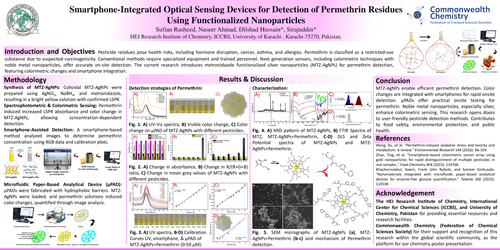
Introduction and Objectives: Pesticide residues pose health risks, including hormone disruption, cancer, asthma, and allergies. Permethrin is classified as a restricted-use substance due to suspected carcinogenicity. Conventional methods require specialized equipment and trained personnel. Next generation sensors, including colorimetric techniques with noble metal nanoparticles, offer accurate on-site detection. The current research introduces metronidazole functionalized silver nanoparticles (MTZ-AgNPs) for permethrin detection, featuring colorimetric changes and smartphone integration.
Methodology
Synthesis of MTZ-AgNPs: Colloidal MTZ-AgNPs were prepared using AgNO3, NaBH4, and metronidazole, resulting in a bright yellow solution with confirmed LSPR.
Spectrophotometric & Colorimetric Sensing: Permethrin induced increased LSPR absorbance and color change in MTZ-AgNPs, allowing concentration-dependent detection.
Smartphone-Assisted Detection: A smartphone-based method analyzed images to determine permethrin concentration using RGB data and calibration plots.
Microfluidic Paper-Based Analytical Device (µPAD): µPADs were fabricated with hydrophobic barriers. MTZ-AgNPs were loaded, and permethrin solutions induced color changes, quantified through image analysis.
Results & Discussion
Detection strategies of Permethrin:
Fig. 1. A) UV-Vis spectra, B) Visible color change, C) Color change on µPAD of MTZ-AgNPs with different pesticides.
Fig. 2. A) Change in absorbance, B) Change in R/(R+G+B) ratio, C) Change in mean grey values of MTZ-AgNPs with different pesticides.
Fig. 3. A) UV spectra, B-D) Calibration Curves UV, smartphone, & µPAD of MTZ-AgNPs+Permethrin (0-50 µM).
Characterization:
Fig. 4. A) XRD pattern of MTZ-AgNPs, B) FTIR Spectra of MTZ, MTZ-AgNPs+Permethrin, C-D) DLS and Zeta Potential spectra of MTZ-AgNPs and MTZ-AgNPs+Permethrin.
Fig. 5. SEM micrographs of MTZ-AgNPs (a), MTZ-AgNPs+Permethrin (b-c) and mechanism of Permethrin detection.
Conclusion
MTZ-AgNPs enable efficient permethrin detection. Color changes are integrated with smartphones for rapid onsite detection. µPADs offer practical onsite testing for permethrin. Noble metal nanoparticles, especially silver, enhance colorimetric sensing. This research opens doors to user-friendly pesticide detection methods. Contributes to food safety, environmental protection, and public health.
References
Wang, Xu, et al. "Permethrin-induced oxidative stress and toxicity and metabolism. A review." Environmental Research 149 (2016): 86-104.
Zhao, Ting, et al. "Smartphone-based colorimetric sensor array using gold nanoparticles for rapid distinguishment of multiple pesticides in real samples." Food Chemistry 404 (2023): 134768.
Khachornsakkul, Kawin, Frank John Rybicki, and Sameer Sonkusale. "Nanomaterials integrated with microfluidic paper-based analytical devices for enzyme-free glucose quantification." Talanta 260 (2023): 124538.
Acknowledgement
The HEJ Research Institute of Chemistry, International Center for Chemical Sciences (ICCBS), and University of Chemistry, Pakistan for providing essential resources and research facilities.
Commonwealth Chemistry (Federation of Chemical Sciences Society) for their support and recognition of this research within the global scientific community, as the platform for our chemistry poster presentation.