253 posters, 14 videos, 27 audios, 14 topics, 392 authors, 132 institutions
ePostersLive by SciGen Technologies S.A. All rights reserved.
4th Commonwealth Chemistry Posters
October 4 - 5, 2023 | Online, United Kingdom

P203
The Behaviour of the Wheel-and-Axle Host Compound 1,4-Bis(diphenylhydroxymethyl)benzene in Mixed Pyridyl Guest Solvents
Poster Presenter
Authors
Affiliations
Part of Topic
Industry, innovation and infrastructure
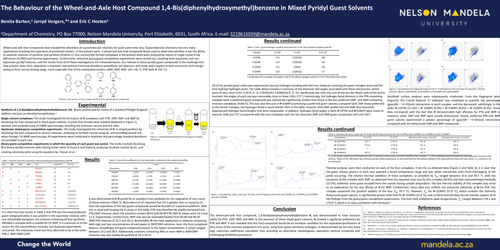
Wheel-and-axle host compounds have enjoyed the attentions of supramolecular chemists for quite some time now. Supramolecular chemistry has very many applications including the separation of positional isomers. In the present work , a wheel and axle host compound H was used to determine whether it has the ability to separate mixtures of picolines and pyridine (Scheme 1). Any successfully formed complexes in the present work were analysed by means of single crystal X-ray diffraction (SCXRD) and thermal experiments. Furthermore, extensive guest/guest competition experiments were carried out, involving both equimolar and non-equimolar pyridyl mixtures, and the results from all of these investigations are contained herein. Our interest in these pyridyl guest compounds is the challenge that they present when their separation is required: conventional fractional distillation procedures are laborious and costly (with respect to both economics and energy) owing to their narrow boiling range, more especially that of the methylated isomers (2MP, 3MP, 4MP, 129‒145 °C; PYR boils at 116 °C).
Synthesis of 1,4-bis(diphenylhydroxymethyl)benzene (H). H was synthesized by means of a standard PhMgBr Grignard addition reaction on dimethyl terephthalate.1
Single solvent complexes: The study investigated the formation of H complexes with PYR, 2MP, 3MP, and 4MP by dissolving the host compound in these guest solvents. Crystals that formed were isolated (depicted in Figure 1), washed, and analyzed using 1H-NMR spectroscopy, revealing the inclusion success and H:G ratio.
Equimolar mixed guest competition experiments. The study investigated the selectivity of H in mixed pyridines by dissolving the host compound in various mixtures, analysing so-formed crystals using GC, and providing overall H:G ratios through 1H-NMR spectroscopy. All experiments were conducted in duplicate and percentage standard deviations are provided in each case.
Binary guest competition experiments in which the quantity of each guest was varied. The study involved dissolving H in binary pyridyl mixtures with varying molar ratios of Guest A and Guest B, analyzing resultant crystals by GC, and creating selectivity plots using the equation by Pivovar et al. 2
It is clear from the results in Table 1 that PYR was the most preferred guest compound when it was present in the equimolar mixture, with one remarkable exception: the solution containing all four pyridines afforded a complex with a notable 85.1% 4MP. It is uncertain as to the reason for this extraordinary anomaly, but duplicate experiments concurred. The selectivity trend was thus observed to be in the order PYR>> 4MP>3MP>2MP.
It was determined that H would be an excellent host candidate for the separation of very many of these mixtures (Table 2). Nassimbeniet al3 reported that if K is greater than or equal to 10, then the separation of the two guest compounds would be feasible on a practical platform. With this in mind and viewing the K values in this table, PYR may therefore be readily extracted from PYR/2MP mixtures when the solutions contain 40:60 and 60:40 PYR:2MP (K values were 16.3 and 12.4, respectively). Furthermore, 4MP may also be separated facilely from 60:40 and 80:20 4MP/PYR mixtures (K 32.5 and 20.2). Remarkably, H may have application in mixtures containing both high and low concentrations of each guest in 3MP/2MP solutions: here, the host compound favours, exceedingly, the guest compound present in the higher concentration; K values ranged between 24.2 and 38.9. Additionally, solutions containing 40% or more 4MP in 4MP/2MP mixtures may also readily be purified (K 39.5‒60.3)
All of the pyridyl guest molecules experienced classical hydrogen bonding with the host molecule involving the guest nitrogen atom and the host hydroxyl hydrogen atom. The table above contains a summary of the distances and angles associated with these interactions, which were all very short (2.01‒2.04 Å, H···A; 2.8195(16)−2.8384(16) Å, D···A), significantly less than the sum of the van der Waals radii of the atoms involved; the angles of each one was reasonably close to linear (165‒171°). Interestingly, the hydrogen bond distance in the PYR-containing complex (with a preferred guest compound) was statistically significantly shorter than those in the less preferred 2MP- and 3MP-containing inclusion complexes (Table 3). This was also the case in H‧2(4MP) (containing a preferred guest species) compared with 2MP (least preferred): in the former complex, the hydrogen bond is much shorter than in the latter instance. Only 4MP (preferred) and 3MP (less favoured) experienced hydrogen bond lengths that were comparable. In addition, hydrogen bond angles in both H‧2(PYR) and H‧2(4MP) were closer to linearity (168 and 171°) compared with the two complexes with the less favoured 2MP and 3MP guest compounds (165 and 166°).
Hirshfield surface analyses were subsequently conducted. From the fingerprint plots (Figure2), the Crystal Explorer 17 software4 was employed to quantify the percentage (guest)N‧‧‧H‒O(host) interactions in each complex, and this decreased, satisfyingly, in the order H‧2(PYR) (11.4%) > H‧2(4MP) (9.3%) > H‧2(3MP) (8.6%) > H‧2(2MP) (8.2%). These data correspond with the fact that H demonstrated high affinities for PYR and 4MP in mixtures, while 2MP and 3MP were usually disfavoured. Clearly, preferred PYR and 4MP guest species experienced a greater percentage of (guest)N‧‧‧H‒O(host) interactions compared with the disfavoured 2MP and 3MP compounds.
Thermal analyses were then conducted on each of the four complexes. From the so obtained data (Figure 3 and Table 4), it is clear that the guest release process in each case spanned a broad temperature range and was rather convoluted, with much overlapping of the peaks occurring. The relative thermal stabilities of these complexes, as provided by Ton, ranged between 47.6 and 59.7 °C, with the exception of the complex with 3MP: as observed from the required mass loss for this complex (29.6%) and that measured experimentally (13.3%), evidently some guest escaped from the crystals during sample preparation. The low thermal stability of this complex may serve as an explanation for the low affinity of H for 3MP. Furthermore, these data also confirm the enhanced selectivity of H for PYR: this complex possessed the greatest stability of the four (Ton 59.7 °C). However, Ton for H‧2(2MP) (57.8 °C), which contains the distinctly disfavoured guest species, is significantly greater than that for H‧2(4MP) (47.6 °C), and so these thermal data do not entirely support all of the findings from the guest/guest competition experiments. The host melt endotherm peak temperatures, Tp, ranged between 178.2 and 179.8 °C which is in close correlation with literature.5
The wheel-and-axle host compound, 1,4-bis(diphenylhydroxymethyl)benzene H, was demonstrated to have inclusion ability for PYR, 2MP, 3MP, and 4MP. In the presence of these mixed guest solvents, H showed a significant preference for PYR and 4MP. It was revealed that this host compound would be an excellent candidate for the separation/purification of very many of the mixtures prepared in this work, using host−guest chemistry strategies, as demonstrated by the very many high selectivity coefficients calculated, thus providing an alternative advantageous separation method compared with challenging distillation procedures.
(1) Weber, E.; Skobridis, K.; Wierig, A.; Nassimbeni, L. R.; Johnson, L. Complexation with Diol Host Compounds. Part 10. Synthesis and Solid State Inclusion Properties of Bis(Diarylhydroxymethyl)-Substituted Benzenes and Biphenyls; X-Ray Crystal Structures of Two Host Polymorphs and of a Non-Functional Host Analogue. Journal of the Chemical Society, Perkin Transactions 21992, No. 12, 2123–2130. https://doi.org/10.1039/P29920002123.
(2) Pivovar, A. M.; Holman, K. T.; Ward, M. D. Shape-Selective Separation of Molecular Isomers with Tunable Hydrogen-Bonded Host Frameworks. Chemistry of Materials2001, 13 (9), 3018–3031. https://doi.org/10.1021/cm0104452.
(3) Nassimbeni, L. R.; Sykes, N. M. Inclusion Compounds: Structure, Kinetics and Selectivity. Crystallogr Rev2022, No. May. https://doi.org/10.1080/0889311X.2022.2067849.
(4) Wolff, S. K.; Grimwood, D. J.; McKinnon, J. J.; Jayatilaka, D.; Spackman, M. A. Crystalexplorer 17.5. University of Western Australia. University of Western Australia: Perth 2007. http://hirshfeldsurface.net. (accessed 2023-06-28).
(5) Abdul-Hussain Karim, S. The Synthesis of Novel Polymers of Intrinsic Microporosity for Potential Application as Gas Separation Membranes; 2016.