253 posters, 14 videos, 27 audios, 14 topics, 392 authors, 132 institutions
ePostersLive by SciGen Technologies S.A. All rights reserved.
4th Commonwealth Chemistry Posters
October 4 - 5, 2023 | Online, United Kingdom

P198
Anti-corrosion studies of a tryptamine Schiff base ligand
Part of Topic
Industry, innovation and infrastructure
Title: Anti-corrosion studies of a tryptamine Schiff base ligand
INTRODUCTION
Schiff bases are characterized by the -C=N- (imine functional group). They have found various applications in medicines as anti-inflammatory, antimicrobial and anti-tumor agents. Their other uses include catalysis, herbicidal, antiseptic, dyes and polymers [1]. Recent researches have reported their application as corrosion inhibitors because their electron rich imine centers adsorbed and form corrosion inhibiting surface films [2, 3].
Tryptamine is an alkaloid with an indole ring and a primary amine (Figure 1). It is an important precursor to serotonin (a neurotransmitter). Both indole and tryptamine have been reported to have been isolated from plants and animals [4, 5].
Tryptamine Schiff base Several Schiff bases have been studied for the prevention of corrosion, however the tryptamine Schiff base 2-((2-(1H-indol-3-yl)ethyl) methylene) -λ4-azanyl)-λ3-methyl)-6-methoxyphenol (HL2) with chemical formula C18H18N2O2 has not been investigated for its anti-corrosion characteristics. Hence this study was done using Density Functional Theory (DFT) to determine the behavior of a previously synthesized and characterised tryptamine Schiff base HL2 [6], as an anti-corrosion compound.
METHODOLOGY
To study the mechanism of inhibition of HL2, the computational simulation of its molecular properties was carried out using Density Functional Theory (DFT) calculations, using the Becke-3-Lee-Yang-Parr exchange (B3LYP), together with the standard double-zeta plus polarization 6-311G (d, p) basis set [B3LYP/6-31G(d)] implemented in the GAUSSIAN 03 software. Chemical parameters obtained include:
ü Energy gap (ΔE),
ü absolute electro negativity (χ),
ü global hardness (η)
ü softness (σ )
ü number of transferred electrons (N)
ü back donation (ΔEd-b)
ü
RESULTS AND DISCUSSION
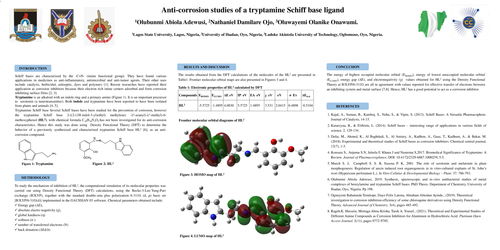
The results obtained from the DFT calculations of the molecules of the HL2 are presented in Table1. Frontier molecular orbital maps are also presented in Figures 3 and 4.
CONCLUSION
The energy of highest occupied molecular orbital (EHOMO), energy of lowest unoccupied molecular orbital (ELUMO), energy gap (ΔE), and electronegativity (χ) values obtained for HL2 using the Density Functional Theory at B3LYP/6-311G are all in agreement with values reported for effective transfer of electrons between an inhibiting system and metal surface [7,8]. Hence, HL2 has a good potential to act as a corrosion inhibitor.