253 posters, 14 videos, 27 audios, 14 topics, 392 authors, 132 institutions
ePostersLive by SciGen Technologies S.A. All rights reserved.
4th Commonwealth Chemistry Posters
October 4 - 5, 2023 | Online, United Kingdom

P193
Design of a 3D potentially auxetic polymer for biomedical applications
Poster Presenter
Authors
Affiliations
Part of Topic
Industry, innovation and infrastructure
Design of a potentially auxetic polymer for biomedical applications
Maria A. Cardona,1 Volpi S.,2 Joseph N. Grima,1,3 Alessandro Casnati,2 Ruben Gatt1
1 Metamaterials Unit, Faculty of Science, University of Malta, Msida, MSD2080, Malta;
2 Dipartimento di Scienze Chimiche, della Vita e della Sostenibiltà Ambientale, Università degli Studi di Parma, Italy;
3 Department of Chemistry, Faculty of Science, University of Malta, Msida, MSD2080, Malta.
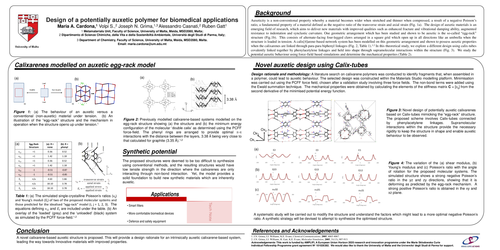
Auxeticity is a non-conventional property whereby a material becomes wider when stretched and thinner when compressed, a result of a negative Poisson’s ratio, a fundamental property of a material defined as the negative ratio of the transverse strain and axial strain (Fig. 1a). The design of auxetic materials is an emerging field of research, which aims to deliver new materials with improved qualities such as enhanced fracture and vibrational damping ability, augmented resistance to indentation and synclastic curvature. One geometric arrangement which has been studied and shown to be auxetic is the so-called “egg-rack” structure (Fig.1b). This consists of alternate-facing four-legged claws arranged in a square grid which open up in all directions like an umbrella when the structure is loaded in tension. A calix[4]arene-based network system has been modelled on this geometric arrangement and shown to possess auxetic properties when the calixarenes are linked through para-para biphenyl linkages (Fig. 2, Table 1).1,2 In this theoretical study, we explore a different design using calix-tubes covalently linked together by phenylacetylene linkages and held into shape through supramolecular interactions within the structure (Fig. 3). We study the potential auxetic behaviour using force-field based simulations and determine the mechanical properties (Table 2).