253 posters, 14 videos, 27 audios, 14 topics, 392 authors, 132 institutions
ePostersLive by SciGen Technologies S.A. All rights reserved.
4th Commonwealth Chemistry Posters
October 4 - 5, 2023 | Online, United Kingdom

P189
On the Potential Auxeticity of Covalent Organic Frameworks
Part of Topic
Industry, innovation and infrastructure
On the Potential Auxeticity of Covalent Organic Frameworks
Muscat G. A.1, Grima, J.N.1,2, Farrugia P. S.1, Cardona M. A.1, Gatt R.1
1 Metamaterials Unit, Faculty of Science, University of Malta, Msida, MSD 2080, Malta
2 Department of Chemistry, Faculty of Science, University of Malta, Msida, MSD 2080, Malta
grace.muscat.16@um.edu.mt
Introduction
Covalent Organic Frameworks (COFs) are a class of engineered porous, molecular crystals composed of organic building blocks linked together through covalent bonds.1 These compounds are characterised by a large surface area, tuneable pore size and structure, low density and structure customisation.2 Due to such properties, COFs have versatile applications such as adsorbents, for the removal of organic pollutants,3 & metal ions from aqueous solutions4 and the capturing of gas molecules.5 Current mechanical investigations on the potential of observing auxeticity in COFs have been confined to 2D COFs, where Poisson's ratio of approaching -1.5 have been demonstrated.6 Conversely, no prior literature on the mechanical properties of 3D COFs has been published. In view of this, a cohort of 3D COFs were studied, and COF 320 was identified as a potentially auxetic 3D COF using molecular simulations in Materials Studio 6.1.7 A method to study the effect of guest molecules was developed to mimic the effect of air on caged systems, thereby better predicting the potential auxetic properties of experimental structures. This study offers insight into the potential auxeticity of existing 3D COFs, paving the way for the design of other inherently auxetic 3D COFs.
Methodology
1. Literature Search
•Identification of existing 3D COFs
2. Sorption Simulations
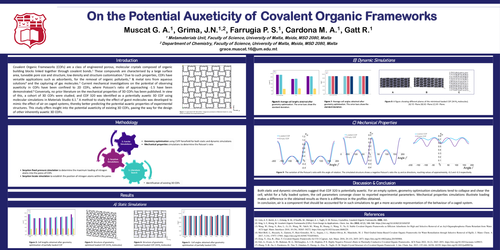
Both static and dynamic simulations suggest that COF 320 is potentially auxetic. For an empty system, geometry optimisation simulations tend to collapse and shear the cell, whilst for a fully loaded system, the cell parameters converge closer to reported experimental parameters. Mechanical properties simulations illustrate loading makes a difference in the obtained results as there is a difference in the profiles obtained.
In conclusion, air is a component that should be accounted for in such simulations to get a more accurate representation of the behaviour of a caged system.
References