Loading...

16 posters, 11 topics, 56 authors, 21 institutions

ePostersLive by SciGen Technologies S.A. All rights reserved.

74

PET CT Scans Requested by Royal Free Hospital Rheumatology Department: A review of compliance with national guidelines and comparison with findings from a national audit
Part of Topic

CT and PET-CT

PET CT Scans Requested by Royal Free Hospital Rheumatology Department: A review of compliance with national guidelines and comparison with findings from a national audit
Sarah Ive 1, Simon Black 2, Animesh Singh 3, Arum Parthipun 3
Luton and Dunstable University Hospital 1, University College London Hospitals NHS Foundation Trust 2, Royal Free Hospital 3

Background

PET CT scans are utilised within the Rheumatology department to assist in the diagnosis and management of non-oncological, inflammatory conditions. The Royal College of Radiologists (RCR) and British Nuclear Medicine Society (BNMS) have compiled evidence-based guidelines on indications for the use of PET CT scans in the United Kingdom. 1-3

PET CT scan indications of relevance to Rheumatology fall under the categories of:

1.Suspicion of vasculitis or suspicion of vasculitis relapse (large vessel vasculitis)
2.Sarcoidosis- assessment of disease activity at baseline 
3.Sarcoidosis- assessment of response to treatment
4. Pyrexia of unknown origin or determining infection in immunocompromised patients
5.Inflammatory disorders (excluding sarcoidosis and vasculitis), including, diagnosis and prognostication of idiopathic retroperitoneal fibrosis and as a “problem-solving tool” in complex autoimmune disease cases.1-4

Regular audits should be performed to assess hospital and departmental compliance to national guidelines.

Aim of Clinical Audit

1.To evaluate the indications for PET CT scans and their influence on patient management within the Rheumatology Department at Royal Free Hospital, an Academic Tertiary Rheumatology Centre.
2.To inform ongoing governance of non-oncological indications of PET CT scans.

Target

To assess the compliance of PET CT requests within the local Rheumatology Department with national guidelines and compare audit findings with results from a BNMS national audit. 

Methodology

Data was collected on all PET CT scans which were requested by the Rheumatology Department over a 12-month period. Collected data included patient age, time taken from clinician request to performing the scan, clinical indication, patient diagnosis, findings on PET CT scan and whether these findings directly influenced patient management or not. Information was collected from EPR and PACS. Microsoft excel was used to perform downstream data analysis.

Results & Discussion

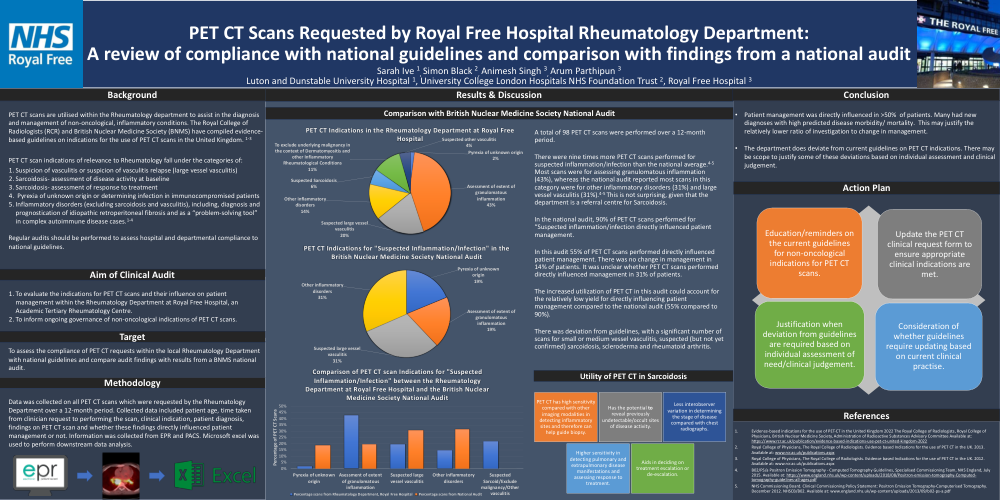
A total of 98 PET CT scans were performed over a 12-month period.

There were nine times more PET CT scans performed for suspected inflammation/infection than the national average.4-5 Most scans were for assessing granulomatous inflammation (43%), whereas the national audit reported most scans in this category were for other inflammatory disorders (31%) and large vessel vasculitis (31%).4-5 This is not surprising, given that the department is a referral centre for Sarcoidosis.

In the national audit, 90% of PET CT scans performed for “Suspected inflammation/infection directly influenced patient management.

In this audit 55% of PET CT scans performed directly influenced patient management. There was no change in management in 14% of patients. It was unclear whether PET CT scans performed directly influenced management in 31% of patients.

The increased utilization of PET CT in this audit could account for the relatively low yield for directly influencing patient management compared to the national audit (55% compared to 90%).

There was deviation from guidelines, with a significant number of scans for small or medium vessel vasculitis, suspected (but not yet confirmed) sarcoidosis, scleroderma and rheumatoid arthritis.

Utility of PET CT in Sarcoidosis

•PET CT has high sensitivity compared with other imaging modalities in detecting inflammatory sites and therefore can help guide biopsy.
•Has the potential to reveal previously undetectable/occult sites of disease activity.
•Less interobserver variation in determining the stage of disease compared with chest radiographs.
•Higher sensitivity in detecting pulmonary and extrapulmonary disease manifestations and assessing response to treatment.
•Aids in deciding on treatment escalation or de-escalation.

Conclusion

•Patient management was directly influenced in >50%  of patients. Many had new diagnoses with high predicted disease morbidity/ mortality.  This may justify the relatively lower ratio of investigation to change in management.
•The department does deviate from current guidelines on PET CT indications. There may be scope to justify some of these deviations based on individual assessment and clinical judgement.

Action Plan

•Education/reminders on the current guidelines for non-oncological indications for PET CT scans.
•Update the PET CT clinical request form to ensure appropriate clinical indications are met.
•Justification when deviation from guidelines are required based on individual assessment of need/clinical judgement.
•Consideration of whether guidelines require updating based on current clinical practise.
 
References
 
1.Evidence-based indications for the use of PET-CT in the United Kingdom 2022 The Royal College of Radiologists, Royal College of Physicians, British Nuclear Medicine Society, Administration of Radioactive Substances Advisory Committee Available at: https://www.rcr.ac.uk/publication/evidence-based-indications-use-pet-ct-united-kingdom-2022
2.Royal College of Physicians, The Royal College of Radiologists. Evidence based Indications for the use of PET CT in the UK. 2013. Available at: www.rcr.ac.uk/publications.aspx
3.Royal College of Physicians, The Royal College of Radiologists. Evidence based Indications for the use of PET CT in the UK. 2012. Available at: www.rcr.ac.uk/publications.aspx
4.B02/PS/a Positron Emission Tomography - Computed Tomography Guidelines, Specialised Commissioning Team, NHS England, July 2015. Available at: https://www.england.nhs.uk/wp-content/uploads/2018/08/Positron-emission-tomography-Computed-tomography-guidelines-all-ages.pdf
5.NHS Commissioning Board. Clinical Commissioning Policy Statement: Positron Emission Tomography-Computerised Tomography. December 2012. NHSCB/B02. Available at: www.england.nhs.uk/wp-content/uploads/2013/09/b02-ps-a.pdf
Copyright © 2015-2026, ePostersLive® SciGen is a registered trademark of SciGen Technologies S.A. Patent pending.

This website and third-party tools we use rely on cookies for the best user experience. By selecting "I agree", you agree to cookie usage as described in our Privacy Policy.