16 posters, 11 topics, 56 authors, 21 institutions
ePostersLive by SciGen Technologies S.A. All rights reserved.
Clinical Radiology Audit ePoster Competition 2024
22 NOVEMBER, 2024 | LONDON, UK
65
Audit of Head CT – Lens Exclusion
Poster Presenter
Part of Topic
CT and PET-CT
AUDIT OF HEAD CT – LENS EXCLUSION
Dr Fatima Ibrahim Shaikh
Radiology Department, Saint Mary’s Hospital , Isle of Wight NHS Trust , UK
CT heads are one of the most common investigations performed in radiology department across the country.Exclusion of the lens on a standard CT brain examination is ideal reducing the radiation dose to the eyes and the likelihood of lens damage and cataract formation.
AIMS
Assess & improve current compliance of eye lens exclusion of CT brain scans at St Mary’s hospital with RCR Guidance
METHODS
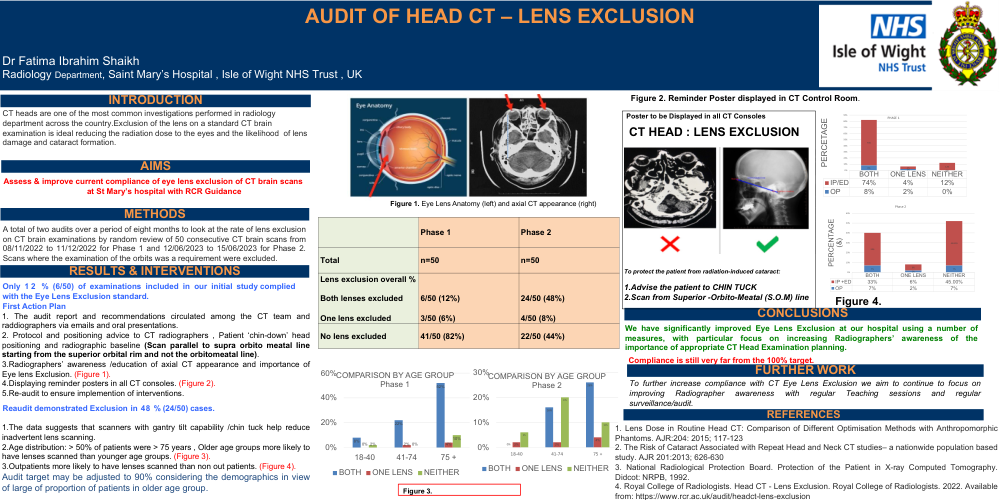
A total of two audits over a period of eight months to look at the rate of lens exclusion on CT brain examinations by random review of 50 consecutive CT brain scans from 08/11/2022 to 11/12/2022 for Phase 1 and 12/06/2023 to 15/06/2023 for Phase 2. Scans where the examination of the orbits was a requirement were excluded.
RESULTS & INTERVENTIONS
Only 12 % (6/50) of examinations included in our initial study complied with the Eye Lens Exclusion standard.
First Action Plan
1. The audit report and recommendations circulated among the CT team and raddiographers via emails and oral presentations.
2. Protocol and positioning advice to CT radiographers , Patient ‘chin-down’ head positioning and radiographic baseline (Scan parallel to supra orbito meatal line starting from the superior orbital rim and not the orbitomeatal line).
3.Radiographers’ awareness /education of axial CT appearance and importance of Eye lens Exclusion. (Figure 1).
4.Displaying reminder posters in all CT consoles. (Figure 2).
5.Re-audit to ensure implemention of interventions.
Reaudit demonstrated Exclusion in 48 % (24/50) cases.
1.The data suggests that scanners with gantry tilt capability /chin tuck help reduce inadvertent lens scanning.
2.Age distribution: > 50% of patients were > 75 years , Older age groups more likely to have lenses scanned than younger age groups. (Figure 3).
3.Outpatients more likely to have lenses scanned than non out patients. (Figure 4).
Audit target may be adjusted to 90% considering the demographics in view of large of proportion of patients in older age group.
CONCLUSIONS
We have significantly improved Eye Lens Exclusion at our hospital using a number of measures, with particular focus on increasing Radiographers’ awareness of the importance of appropriate CT Head Examination planning.
Compliance is still very far from the 100% target.
FURTHER WORK
To further increase compliance with CT Eye Lens Exclusion we aim to continue to focus on improving Radiographer awareness with regular Teaching sessions and regular surveillance/audit.
REFERENCES
1.Lens Dose in Routine Head CT: Comparison of Different Optimisation Methods with Anthropomorphic Phantoms. AJR:204: 2015; 117-123
2.The Risk of Cataract Associated with Repeat Head and Neck CT studies– a nationwide population based study. AJR 201:2013; 626-630
3.National Radiological Protection Board. Protection of the Patient in X-ray Computed Tomography. Didcot: NRPB, 1992.
4.Royal College of Radiologists. Head CT - Lens Exclusion. Royal College of Radiologists. 2022. Available from: https://www.rcr.ac.uk/audit/headct-lens-exclusion