20 posters, 13 topics, 1 sessions, 54 authors, 27 institutions
ePostersLive by SciGen Technologies S.A. All rights reserved.
Clinical Radiology Audit and Quality Improvement ePoster Competitions 2026
30 September, 2026 | London, UK

87
Impact of a Direct-to-CT Stroke Vetting Pathway on Acute Stroke Imaging Times
Poster Presenter
Part of Topic
Neuroradiology
Impact of a Direct-to-CT Stroke Vetting Pathway on Acute Stroke Imaging Times
Dr Faisal Al-Noaaimi (Radiology ST2) | Dr Usmaan Akhtar (Radiology ST3)
Supervisor: Dr Nish Malalasekera (Consultant Interventional Neuroradiologist)
Introduction
Rapid CT head and CT angiography are essential components of acute stroke assessment and timely access to reperfusion therapy. Delays between CT head and CTA may postpone diagnosis and treatment decisions.
This quality improvement project aimed to streamline the local acute stroke imaging pathway. The project aligns with the principles of the National Optimal Stroke Imaging Pathway (NOSIP), which promotes rapid CT head and CTA while minimising avoidable imaging delays.
Aim
- To reduce the CT head-to-CTA interval in suspected acute stroke.
- To evaluate the effect of the direct-to-CT pathway on acute stroke imaging times.
Intervention
A direct-to-CT stroke vetting pathway was introduced locally:
- CT head and CTA requested and vetted together following stroke pre-alert.
- Both examinations performed sequentially.
- Routine on-table review between scans removed.
Method
- A before-and-after quality improvement evaluation was undertaken.
- Two cohorts: 40 cases before pathway change and 40 cases after pathway change.
- CT head and CTA acquisition times were obtained from CRIS/PACS timestamps.
Data Collection
Inclusion criteria
- Suspected acute stroke.
- Presentation through the Emergency Department.
- Imaging requested by the neurology/stroke team.
Exclusion criteria
- Non-ED patients.
- Non-stroke indications, including trauma and strangulation.
Results
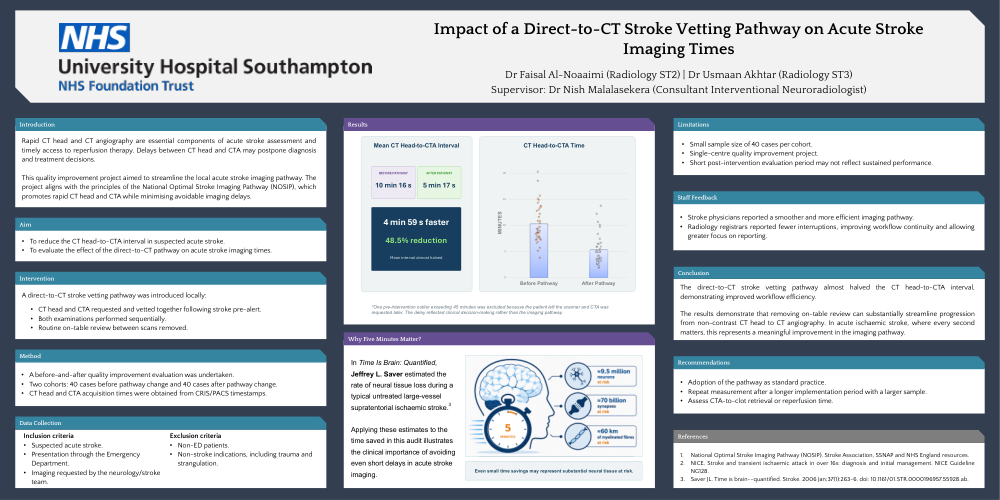
The mean CT head-to-CTA interval decreased from 10 minutes 16 seconds before pathway implementation to 5 minutes 17 seconds after implementation, representing a 4 minute 59 second reduction (48.5%). The mean interval was almost halved.
Limitations
- Small sample size of 40 cases per cohort.
- Single-centre quality improvement project.
- Short post-intervention evaluation period may not reflect sustained performance.
Staff Feedback
- Stroke physicians reported a smoother and more efficient imaging pathway.
- Radiology registrars reported fewer interruptions, improving workflow continuity and allowing greater focus on reporting.
Conclusion
The direct-to-CT stroke vetting pathway almost halved the CT head-to-CTA interval, demonstrating improved workflow efficiency.
The results demonstrate that removing on-table review can substantially streamline progression from non-contrast CT head to CT angiography. In acute ischaemic stroke, where every second matters, this represents a meaningful improvement in the imaging pathway.
Recommendations
- Adoption of the pathway as standard practice.
- Repeat measurement after a longer implementation period with a larger sample.
- Assess CTA-to-clot retrieval or reperfusion time.
References
- National Optimal Stroke Imaging Pathway (NOSIP). Stroke Association, SSNAP and NHS England resources.
- NICE. Stroke and transient ischaemic attack in over 16s: diagnosis and initial management. NICE Guideline NG128.
- Saver JL. Time Is Brain: Quantified. Stroke. 2006;37(1):263-266. doi:10.1161/01.STR.0000196957.55928.AB.