20 posters, 13 topics, 1 sessions, 54 authors, 27 institutions
ePostersLive by SciGen Technologies S.A. All rights reserved.
Clinical Radiology Audit and Quality Improvement ePoster Competitions 2026
30 September, 2026 | London, UK

85
To assess the image quality and radiation dose of EOS slot scanner compared to digital radiography
Part of Topic
MSK
To assess the image quality and radiation dose of EOS 2D/3D imaging system compared to Digital radiography
Introduction
NICE guidelines recognises the benefits of EOS 2D/3D imaging system in terms of reduced radiation dose and increased throughput 1.
NICE does not recommend routine usage of EOS system in the NHS due to high costs and lack of patient benefits from other features like 3D reconstruction, weight bearing imaging and simultaneous PA and lateral view acquisition 1.
NICE encourages use of EOS system in specialist centres to collect data on patient benefits 1.
Methods
Retrospective comparative study between EOS system and digital radiography DR at the Royal Devon and Exeter Hospital.
Timeline: Dec 2024 to April 2025
Data source: PACS
•Image quality- assessed by three independent assessors - orthopaedic registrar(OR), radiology ST5 registrar(RR) and superintendent radiographer(SR).
•Long leg alignment(LL) and whole spine imaging(WS)
(1)Structure not detectable
(2) Structure visible but features not perceptible
(3) Features discernible but not clearly defined
(4) Features clearly defined 2.
Radiation dose- assessed by trainee physicist.
Mann-Whitney U test is used for p-values
Results
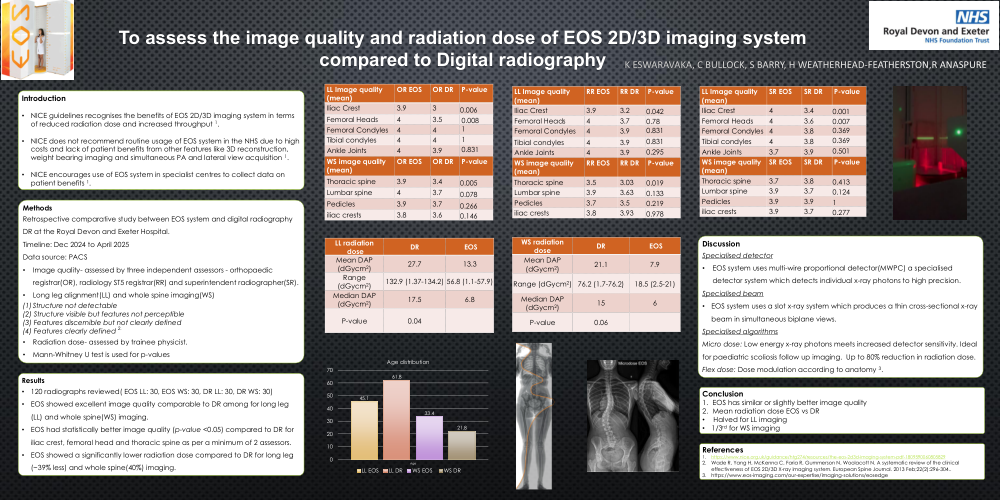
120 radiographs reviewed( EOS LL: 30, EOS WS: 30, DR LL: 30, DR WS: 30)
EOS showed excellent image quality comparable to DR among for long leg (LL) and whole spine(WS) imaging.
EOS had statistically better image quality (p-value <0.05) compared to DR for iliac crest, femoral head and thoracic spine as per a minimum of 2 assessors.
EOS showed a significantly lower radiation dose compared to DR for long leg (~39% less) and whole spine(40%) imaging.
Discussion
Specialised detector
EOS system uses multi-wire proportional detector(MWPC) a specialised detector system which detects individual x-ray photons to high precision.
Specialised beam
EOS system uses a slot x-ray system which produces a thin cross-sectional x-ray beam in simultaneous biplane views.
Specialised algorithms
Micro dose: Low energy x-ray photons meets increased detector sensitivity. Ideal for paediatric scoliosis follow up imaging. Up to 80% reduction in radiation dose.
Flex dose: Dose modulation according to anatomy 3.
Conclusion
EOS has similar or slightly better image quality
Mean radiation dose EOS vs DR
Halved for LL imaging
1/3rd for WS imaging