20 posters, 13 topics, 1 sessions, 54 authors, 27 institutions
ePostersLive by SciGen Technologies S.A. All rights reserved.
Clinical Radiology Audit and Quality Improvement ePoster Competitions 2026
30 September, 2026 | London, UK

41
Audit - Reaudit of our practice of reporting ovarian and adnexal lesions on ultrasound based on guidelines of the ACR and ovarian – adnexal reporting and data system committee.
Poster Presenter
Authors
Affiliations
Part of Topic
Ultrasound
Audit-Reaudit of our practice of reporting ovarian and adnexal lesions on ultrasound based on guidelines of the ACR and ovarian – adnexal reporting and data system committee
Audit Lead: Dr Shilpa Polineni; Supervisor: Dr Emma Owens; Radiology Department, East Sussex Healthcare NHS Trust.
Background
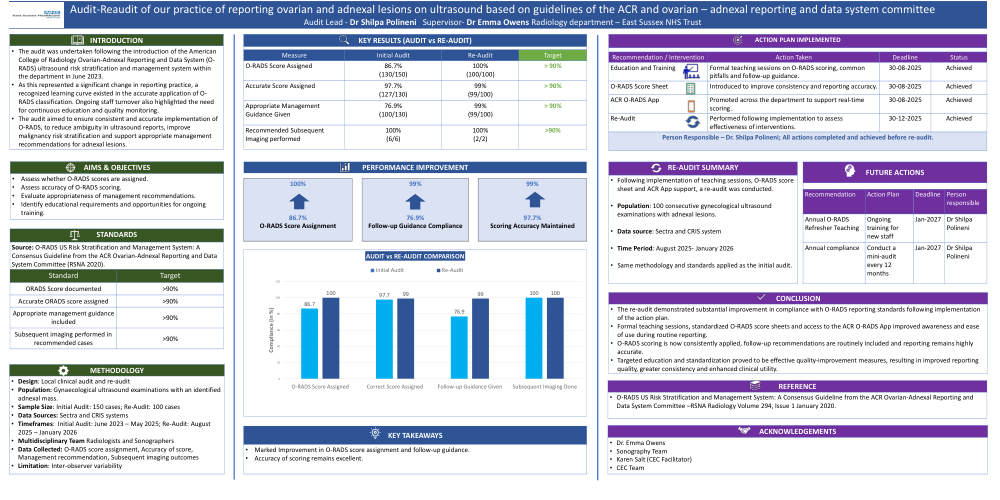
The Ovarian-Adnexal Reporting and Data System (O-RADS) was introduced in the department in June 2023 to standardise ultrasound reporting of ovarian and adnexal lesions, improve malignancy risk stratification, reduce ambiguity in reports, and guide appropriate patient management. Given the learning curve associated with implementing a new reporting system and ongoing staff turnover, an audit was undertaken to assess compliance and identify training needs.
Aim
• Assess whether O-RADS scores are assigned.
• Assess accuracy of O-RADS scoring.
• Assess whether appropriate management is recommended for each risk category?
• Identify educational requirements and opportunities for ongoing training.
•
Methodology
• Population: Gynaecological ultrasound examinations with an identified adnexal mass.
• Sample Size: Initial Audit: 150 cases; Re-Audit: 100 cases
• Data Sources: Sectra and CRIS systems
• Timeframes: Initial Audit: June 2023 – May 2025, Re-Audit: August 2025 – January 2026
• Multidisciplinary Team Radiologists and Sonographers
• Data Collected
• O-RADS score assignment
• Accuracy of score
• Appropriate management recommendation
• Recommended Subsequent imaging performed
Standard
Source: O-RADS US Risk Stratification and Management System: A Consensus Guideline from the ACR Ovarian-Adnexal Reporting and Data System Committee (RSNA 2020).
ACTION PLAN UNDERTAKEN
Following the initial audit, several actions were implemented:
• Formal O-RADS education and training sessions.
• Introduction of a standardized O-RADS score sheet.
• Promotion of the American College of Radiology (ACR) O-RADS App.
• Planned re-audit to assess effectiveness of interventions.
Outcomes
The re-audit demonstrated substantial improvement:
• O-RADS scoring increased from 86.7% to 100%.
• Inclusion of management/follow-up guidance improved from 76.9% to 99%.
• Scoring accuracy remained consistently high (97.7% to 99%).
• Compliance with recommended imaging remained at 100%.
Conclusion
Targeted education, standardised reporting tools, and access to decision-support resources significantly improved compliance with O-RADS reporting standards. The project demonstrated that structured quality improvement measures can enhance reporting consistency, improve clinical usefulness, and support safer patient management. O-RADS scoring is now routinely and accurately applied, with follow-up recommendations consistently included in reports.
Future Plans
• Annual O-RADS refresher training, particularly for new staff and trainees.
• Annual mini-audits to monitor compliance and prevent drift in practice.
Acknowledgement
Dr. Emma Owens, Sonography Team, Karen Salt (CEC Facilitator), CEC Team
Key Take-Home Message: Simple interventions—education, standardisation, and decision-support tools—transformed O-RADS reporting compliance from below target to near-perfect performance, thereby improving the quality and consistency of ultrasound reporting for ovarian and adnexal lesion.