29 posters, 13 topics, 90 authors, 29 institutions
ePostersLive by SciGen Technologies S.A. All rights reserved.
Clinical Radiology Audit and Quality Improvement ePoster Competition 2025
18 NOVEMBER, 2025 | LONDON, UK
95
Closed vs. Open Drainage System: Assessing the Impact on Nephrostomy Dislodgement Rates at Leeds Teaching Hospitals Trust
Poster Presenter
Authors
Affiliations
Part of Topic
Interventional
Closed vs. Open Drainage System: Assessing the impact on nephrostomy dislodgement rates at Leeds Teaching Hospitals Trust
Dr Hind Omer (Radiology Registrar), Dr Priyanka Divekar (Consultant Radiologist), Mrs Michelle Scaiffe (Specialist Radiographer), Mrs Katheryn Murrell (Specialist Radiographer), Dr Ese Adiotomre (Consultant Radiologist), Dr Haroon Motara (Consultant Radiologist), Dr Oliver Hulson (Consultant Radiologist), Dr Atif Khan (Consultant Radiologist), Dr Simon Burbidge (Consultant Radiologist), Dr Taryn Cruickshank (Consultant Radiologist).
Background
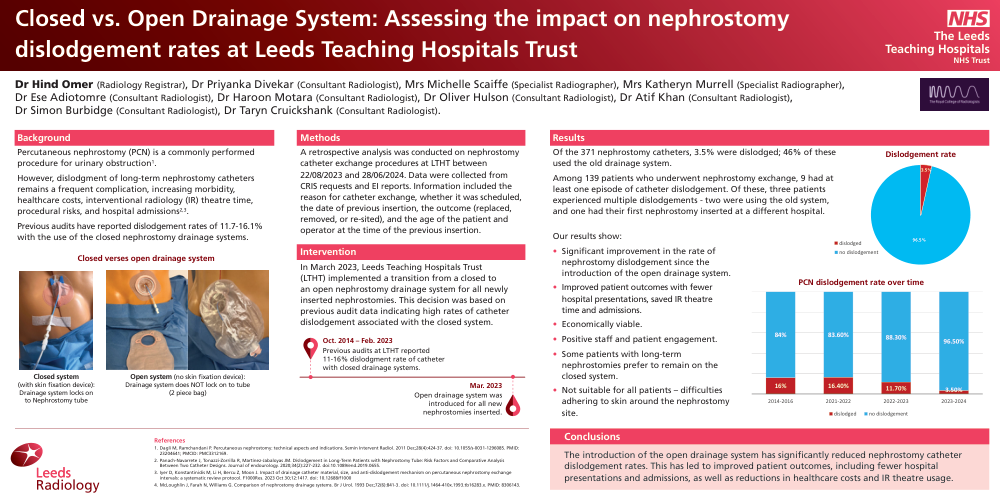
Percutaneous nephrostomy (PCN) is a commonly performed procedure for urinary obstruction. However, dislodgment of long-term nephrostomy catheters remains a frequent complication, increasing morbidity, healthcare costs, interventional radiology (IR) theatre time, procedural risks, and hospital admissions. Previous audits have reported dislodgement rates of 11.7-16.1% with the use of the closed nephrostomy drainage systems.
Methods
A retrospective analysis was conducted on nephrostomy catheter exchange procedures at LTHT between 22/08/2023 and 28/06/2024. Data were collected from CRIS requests and EI reports. Information included the reason for catheter exchange, whether it was scheduled, the date of previous insertion, the outcome (replaced, removed, or re-sited), and the age of the patient and operator at the time of the previous insertion.
Intervention
In March 2023, Leeds Teaching Hospitals Trust (LTHT) implemented a transition from a closed to an open nephrostomy drainage system for all newly inserted nephrostomies. This decision was based on previous audit data indicating high rates of catheter dislodgement associated with the closed system.
Results
Of the 371 nephrostomy catheters, 3.5% were dislodged; 46% of these used the old drainage system. Among 139 patients who underwent nephrostomy exchange, 9 had at least one episode of catheter dislodgement. Of these, three patients experienced multiple dislodgements - two were using the old system, and one had their first nephrostomy inserted at a different hospital.
Our results show:
-
Significant improvement in the rate ofnephrostomy dislodgement since the introduction of the open drainage system.
-
Improved patient outcomes with fewer hospital presentations, saved IR theatre time and admissions.
-
Economically viable.
-
Positive staff and patient engagement.
-
Some patients with long-term nephrostomies prefer to remain on the closed system.
-
Not suitable for all patients – difficultiesadhering to skin around the nephrostomy site.
Conclusion
The introduction of the open drainage system has significantly reduced nephrostomy catheter dislodgement rates. This has led to improved patient outcomes, including fewer hospital presentations and admissions, as well as reductions in healthcare costs and IR theatre usage.