29 posters, 13 topics, 90 authors, 29 institutions
ePostersLive by SciGen Technologies S.A. All rights reserved.
Clinical Radiology Audit and Quality Improvement ePoster Competition 2025
18 NOVEMBER, 2025 | LONDON, UK

85
Port-a-Cath Complication Rates at a DGH
Poster Presenter
Authors
Affiliations
Part of Topic
Interventional
Port-a-Cath Complication Rates at a DGH
ASP. Aslam1, T. Asghar2, R. Bhat2
1 – Victoria Hospital Kirkcaldy, Fife
2 – Department of Radiology, Ninewells Hospital, Dundee
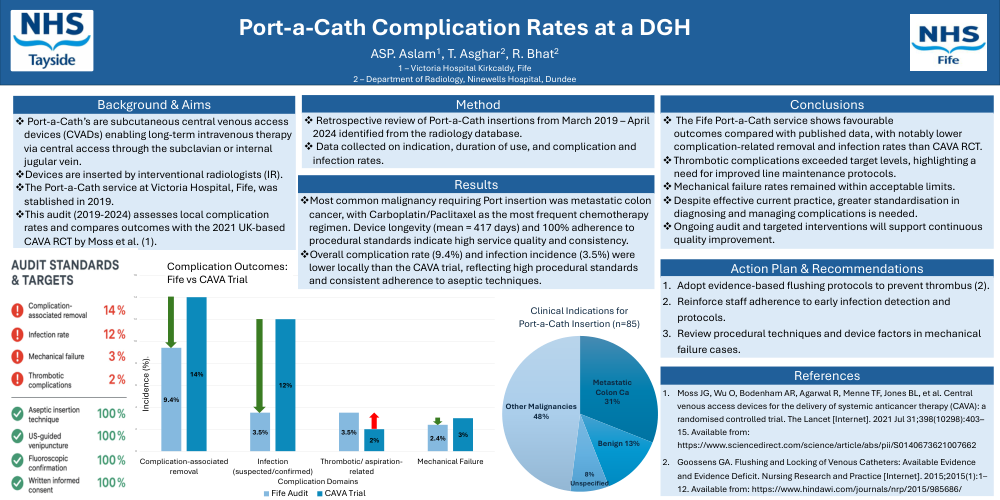
Background & Aims: Port-a-Cath’s are subcutaneous central venous access devices (CVADs) enabling long-term intravenous therapy via central access through the subclavian or internal jugular vein. Devices are inserted by interventional radiologists (IR). The Port-a-Cath service at Victoria Hospital, Fife, was stablished in 2019. This audit (2019-2024) assesses local complication rates and compares outcomes with the 2021 UK-based CAVA RCT by Moss et al. (1).
Method: Retrospective review of Port-a-Cath insertions from March 2019 – April 2024 identified from the radiology database. Data collected on indication, duration of use, and complication and infection rates.
Results: Most common malignancy requiring Port insertion was metastatic colon cancer, with Carboplatin/Paclitaxel as the most frequent chemotherapy regimen. Device longevity (mean = 417 days) and 100% adherence to procedural standards indicate high service quality and consistency. Overall complication rate (9.4%) and infection incidence (3.5%) were lower locally than the CAVA trial, reflecting high procedural standards and consistent adherence to aseptic techniques.
Conclusions: The Fife Port-a-Cath service shows favourable outcomes compared with published data, with notably lower complication-related removal and infection rates than CAVA RCT. Thrombotic complications exceeded target levels, highlighting a need for improved line maintenance protocols. Mechanical failure rates remained within acceptable limits. Despite effective current practice, greater standardisation in diagnosing and managing complications is needed. Ongoing audit and targeted interventions will support continuous quality improvement.
Action Plan & Recommendations: 1.Adopt evidence-based flushing protocols to prevent thrombus (2). 2.Reinforce staff adherence to early infection detection and protocols. 3.Review procedural techniques and device factors in mechanical failure cases.
References: 1.Moss JG, Wu O, Bodenham AR, Agarwal R, Menne TF, Jones BL, et al. Central venous access devices for the delivery of systemic anticancer therapy (CAVA): a randomised controlled trial. The Lancet [Internet]. 2021 Jul 31;398(10298):403–15. Available from: https://www.sciencedirect.com/science/article/abs/pii/S0140673621007662 2.Goossens GA. Flushing and Locking of Venous Catheters: Available Evidence and Evidence Deficit. Nursing Research and Practice [Internet]. 2015;2015(1):1–12. Available from: https://www.hindawi.com/journals/nrp/2015/985686/