29 posters, 13 topics, 90 authors, 29 institutions
ePostersLive by SciGen Technologies S.A. All rights reserved.
Clinical Radiology Audit and Quality Improvement ePoster Competition 2025
18 NOVEMBER, 2025 | LONDON, UK

83
CT Colonography Audit: Evaluation of Technique and Diagnostic Yield in 509 Patients Over a 20-Month Period
Poster Presenter
Authors
Affiliations
Part of Topic
CT and PET-CT
CT Colonography Audit: Evaluation of Technique and Diagnostic Yield in 509 Patients Over a 20-Month Period
Simin Maleki MD, MSc, Komal Shari MBBS, George Cotton MB BCh, Jamal Abdulkarim MBChB, FRCSEd, FRCR
Radiology department, Kettering General Hospital
Introduction
Computed Tomographic Colonography (CTC) is an established modality in colorectal cancer screening, providing a minimally invasive alternative to optical colonoscopy. Adherence to Royal College of Radiologists (RCR) and European Society of Gastrointestinal and Abdominal Radiology (ESGAR) guidelines ensures diagnostic reliability, image quality and patient benefit.
Over a 20-month period, the performance and diagnostic yield of CTC has been assessed by reviewing both colonic and extracolonic outcomes. The focus is on maintaining high-quality imaging while determining the frequency of clinically relevant findings.
Our aim was to identify clinically significant findings in both the colon and extracolonic structures.
Technique
CT colonography was performed in at least two positions (supine and prone) following full bowel preparation and faecal tagging with Gastrografin. Carbon dioxide insufflation was used for colonic distension, and 20 mg IV Buscopan was administered.
For screening patients, low-dose supine and prone scans were acquired. In symptomatic patients, IV contrast was added.
Methodology
A retrospective audit was conducted on 509 patients who underwent CT colonography between March 2023 and November 2024. Data were extracted from radiology information systems, including patient positioning, bowel preparation adequacy and colonic distension.
Colonic and extracolonic findings were reviewed to assess diagnostic yield and clinical relevance. Data were compiled and analysed in Microsoft Excel to evaluate compliance with audit standards and identify areas for quality improvement.
Results
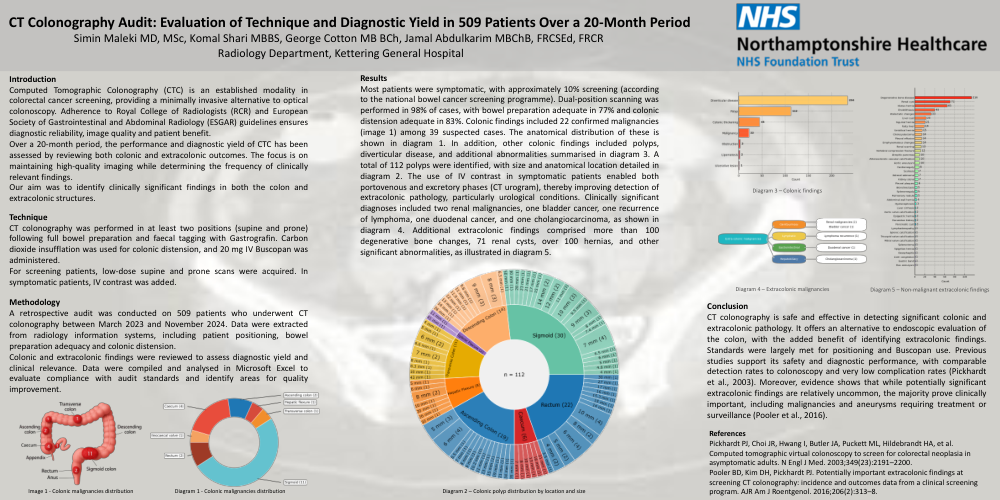
Most patients were symptomatic, with approximately 10% screening (according to the national bowel cancer screening programme). Dual-position scanning was performed in 98% of cases, with bowel preparation adequate in 77% and colonic distension adequate in 83%. Colonic findings included 22 confirmed malignancies (image 1) among 39 suspected cases. The anatomical distribution of these is shown in diagram 1. In addition, other colonic findings included polyps, diverticular disease, and additional abnormalities summarised in diagram 3. A total of 112 polyps were identified, with size and anatomical location detailed in diagram 2. The use of IV contrast in symptomatic patients enabled both portovenous and excretory phases (CT urogram), thereby improving detection of extracolonic pathology, particularly urological conditions. Clinically significant diagnoses included two renal malignancies, one bladder cancer, one recurrence of lymphoma, one duodenal cancer, and one cholangiocarcinoma, as shown in diagram 4. Additional extracolonic findings comprised more than 100 degenerative bone changes, 71 renal cysts, over 100 hernias, and other significant abnormalities, as illustrated in diagram 5.
Conclusion
CT colonography is safe and effective in detecting significant colonic and extracolonic pathology. It offers an alternative to endoscopic evaluation of the colon, with the added benefit of identifying extracolonic findings. Standards were largely met for positioning and Buscopan use. Previous studies support its safety and diagnostic performance, with comparable detection rates to colonoscopy and very low complication rates (Pickhardt et al., 2003). Moreover, evidence shows that while potentially significant extracolonic findings are relatively uncommon, the majority prove clinically important, including malignancies and aneurysms requiring treatment or surveillance (Pooler et al., 2016).
References
Pickhardt PJ, Choi JR, Hwang I, Butler JA, Puckett ML, Hildebrandt HA, et al. Computed tomographic virtual colonoscopy to screen for colorectal neoplasia in asymptomatic adults. N Engl J Med. 2003;349(23):2191–2200.
Pooler BD, Kim DH, Pickhardt PJ. Potentially important extracolonic findings at screening CT colonography: incidence and outcomes data from a clinical screening program. AJR Am J Roentgenol. 2016;206(2):313–8.