372 posters, 1 audios, 13 topics, 29 sessions, 1,035 authors, 449 institutions
ePostersLive by SciGen Technologies S.A. All rights reserved.
51st Annual Regional Anesthesiology and Acute Pain Medicine Meeting
April 16 - 18, 2026 | Phoenix, Arizona

2318803
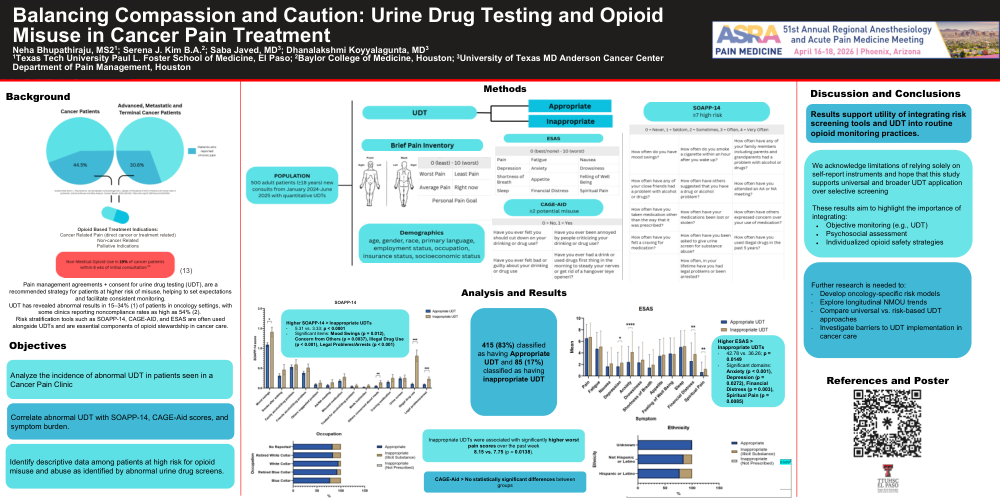
Balancing Compassion and Caution: Urine Drug Testing and Opioid Misuse in Cancer Pain Treatment
Poster Presenter
Part of Topic
Safety/QA/QI Projects
Balancing Compassion and Caution: Urine Drug Testing and Opioid
Misuse in Cancer Pain Treatment
Neha Bhupathiraju, MS21; Serena J. Kim B.A.2; Saba Javed, MD3; Dhanalakshmi Koyyalagunta, MD3
1Texas Tech University Paul L. Foster School of Medicine, El Paso; 2Baylor College of Medicine, Houston; 3University of Texas MD Anderson Cancer Center
Department of Pain Management, Houston
Background
Cancer Patients
Methods
Advanced, Metastatic and
Terminal Cancer Patients
UDT
Appropriate
Inappropriate
Pacients whd
reported
44.5%
30.6%
POPULATION
500 adult patients (218 years)
consults from January 2024-June
2025 with quantitative UDTs
Brief Pain Inventory
O (least) - 10 (worst)
Least Pain
Average Pain Right now
Personal Pain Goal
Worst Pain
Pain
Depression
Shortness of
Breath
Sleep
How often have you
attended an AA or NA
problem?
How often have your
medications been lost or
stolen?
ten have others
expressed concern over
your use of medication?
Opioid Based Treatment Indications:
Cancer Related Pain (direct cancer or treatment related)
Non-cancer Related
Palliative Indications
occunati
Non-Medical Opioid Use in 19% of cancer patients
within 8 wks of initial consultation 10
Pain management agreements + consent for ur
consent for urine drug testing (UDT), are a
recommended strategy for patients at higher risk of misuse, helping to set expectations
and facilitate consistent monitoring.
UDT has revealed abnormal results in 15-34% (1) of patients in oncology settings, with
s revealed abhormal results in 15-347e (T) of patients in oneology st
some clinics reporting noncompliance rates as high as 54% (2).
Risk stratificationtes
tification tools such as SOAPP-14, CAGE-AID, and ESAS are often used
alongside UDTs and are essential components of opioid stewardship in cancer care.
Objectives
Analyze the incidence of abnormal UDT in patients seen in a
Cancer Pain Clinic
Demographics
age, gender, race, primary language,
employ
employment status, occupation,
insurance status, socioeconomic status
(13)
Have you ever felt you
should cut down on your
drinking or drug use?
Have you ever felt bad or
or drug use
Fatigue
Anxiety
Appetite
Financial Distress
CAGE-AID
22 potential misuse
O = No. 1= Yes
you ever been annoyed
Have you eve been annoy
by people criticizing your
drinking or drug use?
Have you ever had a dr
used drugs first thing in the
guilty about your drinking morning to steady your nerves
or get rid of a hangover (eye
or get rid of
opener)?
ESAS
0 (best/none) - 10 (worst)
Nausea
Drowsiness
Felling of Well
Being
Spiritual Pain
mood swings?
after you wake up?
SOAPP-14
27 high risk
0 - Never, 1 - Seldom, 2 - Sometimes, 3 = Often, 4 = Very Often
How often have any of
your family members
How often do you have How often do you smoke
a cigarette within an hour including parents and
grandparents had a
problem with alcohol or
drugs?
Discussion and Conclusions
Results support utility of integrating risk
screening tools and UDT into routine
opioid monitoring practices.
asked to give urine
screen for substance
abuse?
How aften, in your
lifetime have you had
legal problems or been
arrested?
How often have you been
How often have you
used illegal drugs in the
past 5 years?
How often have any of How often have others
your close friends had suggested that you have
a problem with alcobol
a problem with alcohol a drug or alcohol
or drugs?
How often have you
taken medication othe
than the way that it
was prescribed?
How often have you
felt a craving for
nedication?
...
We acknowledge limitations of relying solely on
self-report instruments and hope that this study
supports universal and broader UDT application
over selective screening
These results aim to highlight the importance of
integrating:
Objective monitoring (e.g., UDT)
Psychosocial assessment
Individualized opioid safety strategies
Analysis and Results
Approprate UDT
ESAS
..
SOAPP.14 score
SOAPP-14
Higher SOAPP-14 > Inappropriate UDTs
5.31 vs. 3.33: p < 0.0001
Significant items: Mood Swings (p = 0.012)
m Others (p = 0.0037), Illegal Drug Use
(p < 0.001), Legal Problems/Arrests (p < 0.001)
..**
Correlate abnormal UDT with SOAPP-14, CAGE-Aid scores, and
symptom burden.
profiems
AA/NA meeting
Misused medicatior
Mond swinas
Smoke after waking
amity alcoholidrug probien
Friends atcotoltrug probiem
Othees suggested probiem
ymptoR
Treated for aicuhol/drug probiem
Craving mesication
Meds lost/stolen
Others cuncarned about med
Urine screees
Hegsl drug use
Legai probiems/arres
415 (83%) classified
as having Appropriate
UDT and 85 (17%)
classified as having
inappropriate UDT
Mean
Depression
Anxiety
Mowsiness
Drowsiness
Shortness of Breath
Fe Appetite
Feeling of Well Being
Spiritual Pain
Financial Distress
Appropriate UDT
Inappropriate UDT
Higher ESAS>
Inappropriate UDTs
42.78 vs. 38.26; p =
0.0149
Significant domains
Anxiety (p < 0.001),
Depression (p =
0.0272), Financial
Distress (p = 0.003),
Spiritual Pain (p =
0.0085)
Further research is needed to:
Develop oncology-specific risk models
Explore longitudinal NMOU trends
Compare universal vs. risk-based UDT
approaches
Investigate barriers to UDT implementation in
cancer care
References and Poster
Occupation
Ethnicity
Identify descriptive data among patients at high risk for opioid
misuse and abuse as identified by abnormal urine drug screens.
0309
Occupation
No Reported
Retired White Collar
White Collar
Retired Blue Collar
Blue Collar
Appropriate
Inappropriate
Inap
(Ilicit Substance)
Inappropriate
(Not Prescribed)
Inappropriate UDTs were associated with significantly higher worst
pain scores over the past week
8.15 vs. 7.75 (p = 0.0138).
thnicity
Unknown
Not Hispanic
or Latino
Appropriate
Inappropriat
gstance
(Illicit Substance)
Inappropriate
(Not Prescribed)
CAGE-Aid > No statistically significant differences between
groups
Hispanic or Latinc
150