372 posters, 1 audios, 13 topics, 29 sessions, 1,035 authors, 449 institutions
ePostersLive by SciGen Technologies S.A. All rights reserved.
51st Annual Regional Anesthesiology and Acute Pain Medicine Meeting
April 16 - 18, 2026 | Phoenix, Arizona

2301799
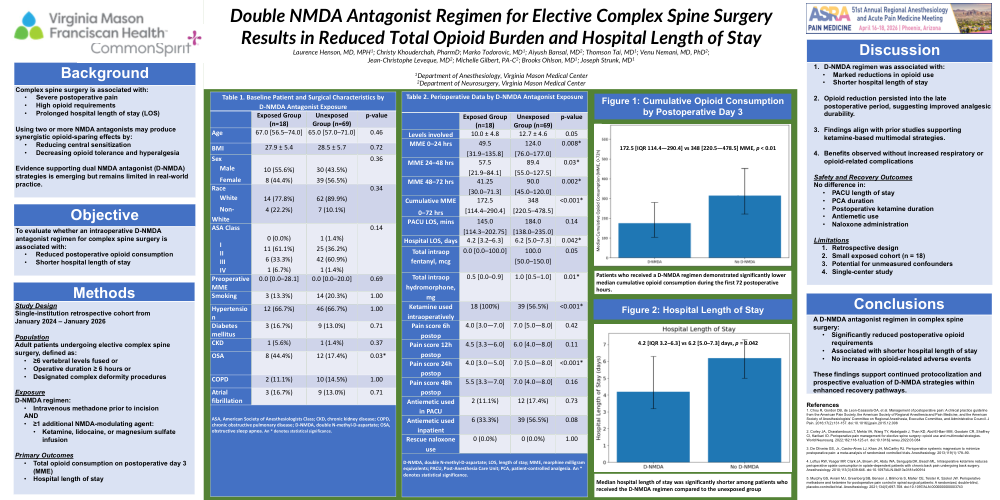
Double NMDA Antagonist Regimen for Elective Complex Spine Surgery Results in Reduced Total Opioid Burden and Hospital Length of Stay
Poster Presenter
Part of Topic
Safety/QA/QI Projects
Background:
Complex spine surgery is associated with:
Using two or more NMDA antagonists may produce synergistic opioid-sparing effects by:
Evidence supporting dual NMDA antagonist (D-NMDA) strategies is emerging but remains limited in real-world practice.
Objective:
To evaluate whether an intraoperative D-NMDA antagonist regimen for complex spine surgery is associated with:
Study Design
Single-institution retrospective cohort from
January 2024 – January 2026
Population
Adult patients undergoing elective complex spine surgery, defined as:
Exposure
D-NMDA regimen:
AND
Primary Outcomes
Safety and Recovery Outcomes
No difference in:
Limitations
Conslusions:
A D-NMDA antagonist regimen in complex spine surgery:
These findings support continued protocolization and prospective evaluation of D-NMDA strategies within enhanced recovery pathways.
References
1. Chou R, Gordon DB, de Leon-Casasola OA, et al. Management of postoperative pain: A clinical practice guideline from the American Pain Society, the American Society of Regional Anesthesia and Pain Medicine, and the American Society of Anesthesiologists’ Committee on Regional Anesthesia, Executive Committee, and Administrative Council. J Pain. 2016;17(2):131-157. doi:10.1016/j.jpain.2015.12.008
2. Corley JA, Charalambous LT, Mehta VA, Wang TY, Abdelgadir J, Than KD, Abd-El-Barr MM, Goodwin CR, Shaffrey CI, Karikari IO. Perioperative pain management for elective spine surgery: opioid use and multimodal strategies. World Neurosurg. 2022;162:118-125.e1. doi:10.1016/j.wneu.2022.03.084
3. De Oliveira GS, Jr., Castro-Alves LJ, Khan JH, McCarthy RJ. Perioperative systemic magnesium to minimize postoperative pain: a meta-analysis of randomized controlled trials. Anesthesiology. 2013;119(1):178–90.
4. Loftus RW, Yeager MP, Clark JA, Brown JR, Abdu WA, Sengupta DK, Beach ML. Intraoperative ketamine reduces perioperative opiate consumption in opiate-dependent patients with chronic back pain undergoing back surgery. Anesthesiology. 2010;113(3):639-646. doi:10.1097/ALN.0b013e3181e90914
5. Murphy GS, Avram MJ, Greenberg SB, Benson J, Bilimoria S, Maher CE, Teister K, Szokol JW. Perioperative methadone and ketamine for postoperative pain control in spinal surgical patients: A randomized, double-blind, placebo-controlled trial. Anesthesiology. 2021;134(5):697-708. doi:10.1097/ALN.0000000000003743