372 posters, 1 audios, 13 topics, 29 sessions, 1,035 authors, 449 institutions
ePostersLive by SciGen Technologies S.A. All rights reserved.
51st Annual Regional Anesthesiology and Acute Pain Medicine Meeting
April 16 - 18, 2026 | Phoenix, Arizona

2318447
Calculating the Value of an Acute Pain & Regional Anesthesia service
Poster Presenter
Authors
Affiliations
Part of Topic
Safety/QA/QI Projects
Introduction:
Most large hospitals have dedicated Regional Anesthesia & Acute Pain (RAP) services.1 For Institutions wherein a concern of limited return on investment has deterred RAP implementation or expansion, the financial forecasting model called the “regional anesthesia calculator” may help remove barriers to establishing this crucial service.
Purpose:
To provide general guidance about revenue prediction for regional anesthesia activities.
Methods:
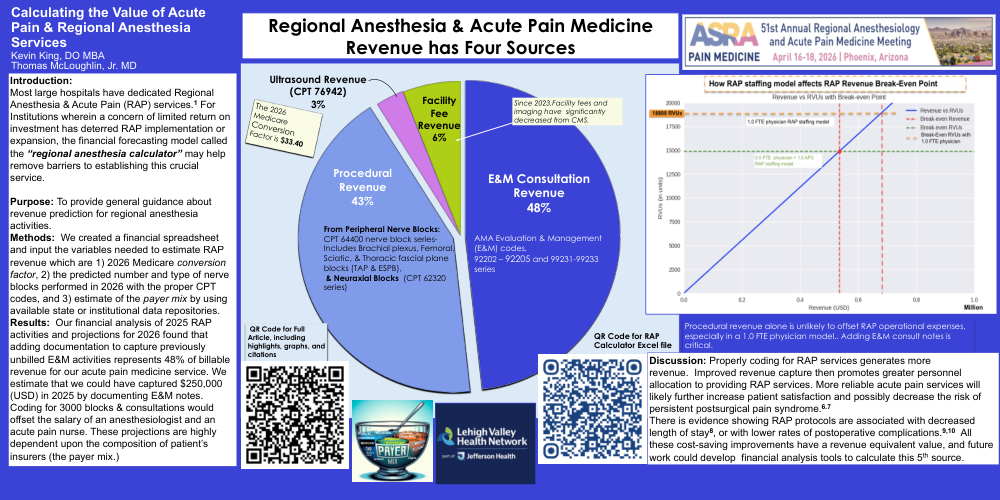
We created a financial spreadsheet and input the variables needed to estimate RAP revenue which are 1) 2026 Medicare conversion factor, 2) the predicted number and type of nerve blocks performed in 2026 with the proper CPT codes, and 3) estimate of the payer mix by using available state or institutional data repositories.
Results:
Our financial analysis of 2025 RAP activities and projections for 2026 found that adding documentation to capture previously unbilled E&M activities represents 48% of billable revenue for our acute pain medicine service. We estimate that we could have captured $250,000 (USD) in 2025 by documenting E&M notes. Coding for 3000 blocks & consultations would offset the salary of an anesthesiologist and an acute pain nurse. These projections are highly dependent upon the composition of patient’s insurers (the payer mix.)
Discussion:
Properly coding for RAP services generates more revenue. Improved revenue capture then promotes greater personnel allocation to providing RAP services. More reliable acute pain services will likely further increase patient satisfaction and possibly decrease the risk of persistent postsurgical pain syndrome.6.7
There is evidence showing RAP protocols are associated with decreased length of stay8, or with lower rates of postoperative complications.9,10 All these cost-saving improvements have a revenue equivalent value, and future work could develop financial analysis tools to calculate this 5th source.