372 posters, 1 audios, 13 topics, 29 sessions, 1,035 authors, 449 institutions
ePostersLive by SciGen Technologies S.A. All rights reserved.
51st Annual Regional Anesthesiology and Acute Pain Medicine Meeting
April 16 - 18, 2026 | Phoenix, Arizona

2317608
RIBcovery: A Multidisciplinary Rib Fracture Clinical Pathway
Poster Presenter
Part of Topic
Safety/QA/QI Projects
Title: RIBcovery: A Multidisciplinary Rib Fracture Clinical Pathway
Authors: Mishan Rambukwella, Ellison Chen, Elliott Schwartz, Mary Alice Vijjeswarapu, Michael Kissen
Introduction:
Rib fractures are some of the most common injuries (incidence of 10-26%) sustained by trauma patients globally. Studies have shown that mortality directly correlates to the number of rib fractures present, especially in the elderly population, due to pain leading to impaired respiratory mechanics [1-3]. With multiple regional anesthetic techniques available to minimize pain, collaborative interdisciplinary pathways targeting pain interventions for rib fractures have been shown to improve patient outcomes [3-5].
Methods:
To inform our pathway, we collaborated with our trauma surgery colleagues to identify the number of admitted patients with rib fractures over two months (May and June 2025). We conducted a retrospective review of these patients to determine how many patients received pain consultations that resulted in epidural placement or regional anesthesia intervention.
Here we present a clinical pathway involving our institution’s trauma surgery, inpatient pain, and regional pain teams aimed at providing timely evaluation and pain interventions for patients admitted with rib fractures.
Results:
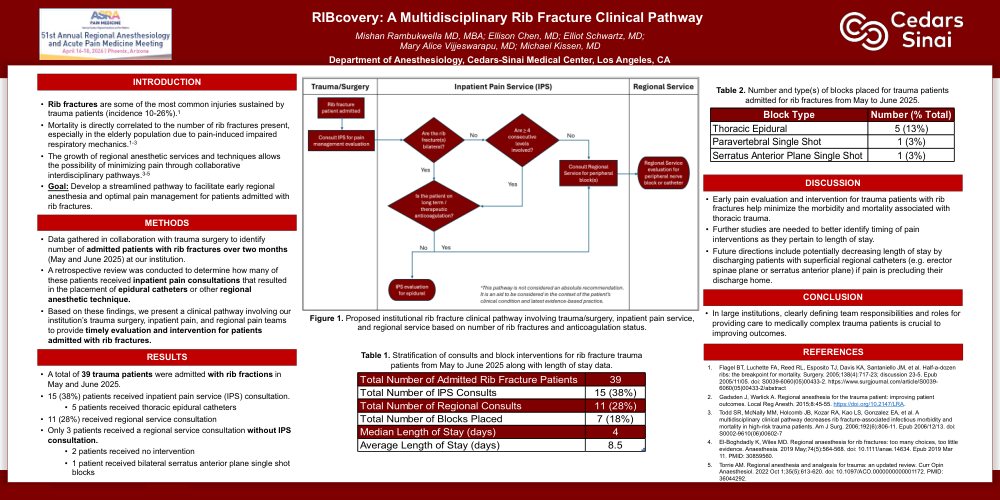
Based on our retrospective review, there were a total of 39 trauma patients admitted with rib fractures at our institution from May to June 2025. Of these patients, 15 (38%) received inpatient pain service (IPS) consultation and 11 (28%) received regional service consultation. There were only 3 cases where the regional service was consulted in absence of IPS consultation; 2 of these cases resulted in no intervention and 1 case resulted in bilateral serratus anterior plane single shot blocks. Of the 15 IPS consultation cases, only 5 received thoracic epidurals.
Under the new pathway (Figure 1), the trauma surgery team will admit the patient and consult the IPS. IPS will evaluate the patient to determine the best method of pain control in the context of the patient’s injuries – multimodal oral/IV regimen, thoracic epidural, or other regional anesthesia technique (including paravertebral, erector spinae plane, or serratus anterior plane). Should a regional anesthesia technique be indicated, the IPS team will notify the regional service for further patient evaluation, including the determination of block type based on location of rib fracture and anticoagulation status.
Discussion
In large institutions, clearly defining team responsibilities for providing care to medically complex trauma patients are crucial to improving their outcomes. This pathway intends to ensure that admitted patients with rib fractures get the appropriate pain evaluation to help minimize the morbidity and mortality associated with thoracic trauma.
Future directions include the potential to decrease length of stay by allowing patients to be discharged with regional catheter pumps for certain regional blocks.
References:
[1] Flagel BT, Luchette FA, Reed RL, Esposito TJ, Davis KA, Santaniello JM, et al. Half-a-dozen ribs: the breakpoint for mortality. Surgery. 2005;138(4):717-23; discussion 23-5. Epub 2005/11/05. doi: S0039-6060(05)00433-2
https://www.surgjournal.com/article/S0039-6060(05)00433-2/abstract
[2] Gadsden J, Warlick A. Regional anesthesia for the trauma patient: improving patient outcomes. Local Reg Anesth. 2015;8:45-55. https://doi.org/10.2147/LRA.S55322
https://www.dovepress.com/regional-anesthesia-for-the-trauma-patient-improving-patient-outcomes-peer-reviewed-fulltext-article-LRA
[3] Todd SR, McNally MM, Holcomb JB, Kozar RA, Kao LS, Gonzalez EA, et al. A multidisciplinary clinical pathway decreases rib fracture-associated infectious morbidity and mortality in high-risk trauma patients. Am J Surg. 2006;192(6):806-11. Epub 2006/12/13. doi: S0002-9610(06)00602-7
https://www.americanjournalofsurgery.com/article/S0002-9610(06)00602-7/abstract
[4] El-Boghdadly K, Wiles MD. Regional anaesthesia for rib fractures: too many choices, too little evidence. Anaesthesia. 2019 May;74(5):564-568. doi: 10.1111/anae.14634. Epub 2019 Mar 11. PMID: 30859560.
https://pubmed.ncbi.nlm.nih.gov/30859560/
[5] Torrie AM. Regional anesthesia and analgesia for trauma: an updated review. Curr Opin Anaesthesiol. 2022 Oct 1;35(5):613-620. doi: 10.1097/ACO.0000000000001172. PMID: 36044292.
https://pubmed.ncbi.nlm.nih.gov/36044292/