383 posters, 2 videos, 1 audios, 8 topics, 28 sessions, 328 authors, 225 institutions
ePostersLive by SciGen Technologies S.A. All rights reserved.
50th Annual Regional Anesthesiology and Acute Pain Medicine Meeting
May 1 - 3, 2025 | Orlando, Florida

6436
ENVIRONMENTAL AND COST SAVINGS IN REGIONAL ANESTHESIA: POWERING-DOWN ULTRASOUND MACHINES BETWEEN SCANS
Poster Presenter
Authors
Part of Topic
Scientific Abstracts > Regional Anesthesia
Environmental and Cost Savings in Regional Anesthesia: Powering-Down Ultrasound Machines Between Scans
Edward Umberto Serghi, BSc1, Ty Deacon, Elizabeth Fouts-Palmer, Deirdre Kelleher, Tareq Salah, Vivian H.Y. Ip MBChB, MRCP, FRCA2
Introduction:
Hospital imaging technology accounts for a significant energy usage in healthcare.
While energy consumption in CT and MRI machines has been studied extensively, the energy consumption of ultrasound machines has been overlooked in the literature as a source of energy waste. Anesthesiologists frequently use ultrasound in regional anesthesia.
Study Aim: to quantify the energy consumption of ultrasound machines and study energy-saving strategies to decrease ultrasound machines' energy usage at our institution. Powering down medical equipment during non-operational times is a potential strategy for reducing energy waste.
Hypothesis: turning the ultrasound machine off when not in use and overnight would significantly decrease energy consumption.
Materials and Methods:
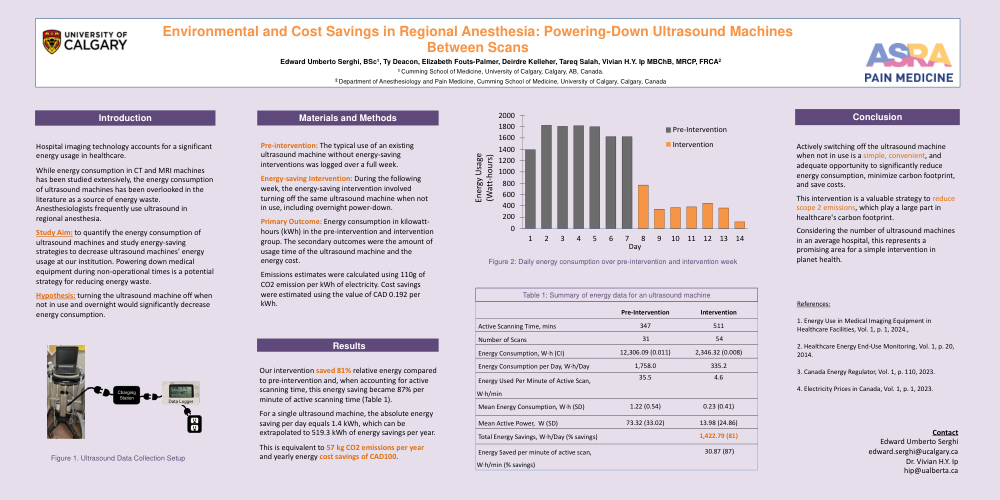
Pre-intervention: The typical use of an existing ultrasound machine without energy-saving interventions was logged over a full week.
Energy-saving Intervention: During the following week, the energy-saving intervention involved turning off the same ultrasound machine when not in use, including overnight power-down.
Primary Outcome: Energy consumption in kilowatt-hours (kWh) in the pre-intervention and intervention group. The secondary outcomes were the amount of usage time of the ultrasound machine and the energy cost.
Emissions estimates were calculated using 110g of CO2 emission per kWh of electricity. Cost savings were estimated using the value of CAD 0.192 per kWh.
Results:
Our intervention saved 81% relative energy compared to pre-intervention and, when accounting for active scanning time, this energy saving became 87% per minute of active scanning time (Table 1).
For a single ultrasound machine, the absolute energy saving per day equals 1.4 kWh, which can be extrapolated to 519.3 kWh of energy savings per year.
This is equivalent to 57 kg CO2 emissions per year and yearly energy cost savings of CAD100.
Conclusion:
Actively switching off the ultrasound machine when not in use is a simple, convenient, and adequate opportunity to significantly reduce energy consumption, minimize carbon footprint, and save costs.
This intervention is a valuable strategy to reduce scope 2 emissions, which play a large part in healthcare's carbon footprint.
Considering the number of ultrasound machines in an average hospital, this represents a promising area for a simple intervention in planet health.
References:
1. Energy Use in Medical Imaging Equipment in Healthcare Facilities, Vol. 1, p. 1, 2024.,
2. Healthcare Energy End-Use Monitoring, Vol. 1, p. 20, 2014.
3. Canada Energy Regulator, Vol. 1, p. 110, 2023.
4. Electricity Prices in Canada, Vol. 1, p. 1, 2023.
Contact
Edward Umberto Serghi
edward.serghi@ucalgary.ca
Dr. Vivian H.Y. Ip
hip@ualberta.ca