383 posters, 2 videos, 1 audios, 8 topics, 28 sessions, 328 authors, 225 institutions
ePostersLive by SciGen Technologies S.A. All rights reserved.
50th Annual Regional Anesthesiology and Acute Pain Medicine Meeting
May 1 - 3, 2025 | Orlando, Florida

6361
SUPERIOR CLUNEAL NERVE BLOCKS OFFER A VIABLE OPTION FOR ACUTE FLARE-UP OF CHRONIC AXIAL LOWER BACK PAIN
Poster Presenter
Authors
Affiliations
UCLA Department of Anesthesiology and Perioperative Medicine
Part of Topic
Scientific Abstracts > Chronic Pain
Superior cluneal nerve blocks offer a viable option for acute flare-up of chronic axial lower back pain
Introduction
Lower back pain (LBP) is a common cause of discomfort, dysfunction, and disability worldwide. A growing body of research suggests that superior cluneal neuralgia is a notable cause of axial LBP.1 Superior cluneal neuralgia can be managed with lifestyle modifications, physiotherapy, and pharmacological treatments.2 If conservative management fails to provide sufficient pain relief, patients may elect to proceed with diagnostic and therapeutic superior cluneal nerve (SCN) blocks with local anesthetic and steroid for longer duration pain relief.2 Additional interventional options include radiofrequency ablation (RFA), peripheral nerve stimulation, and surgical decompression for SCN entrapment.3-5
Methods
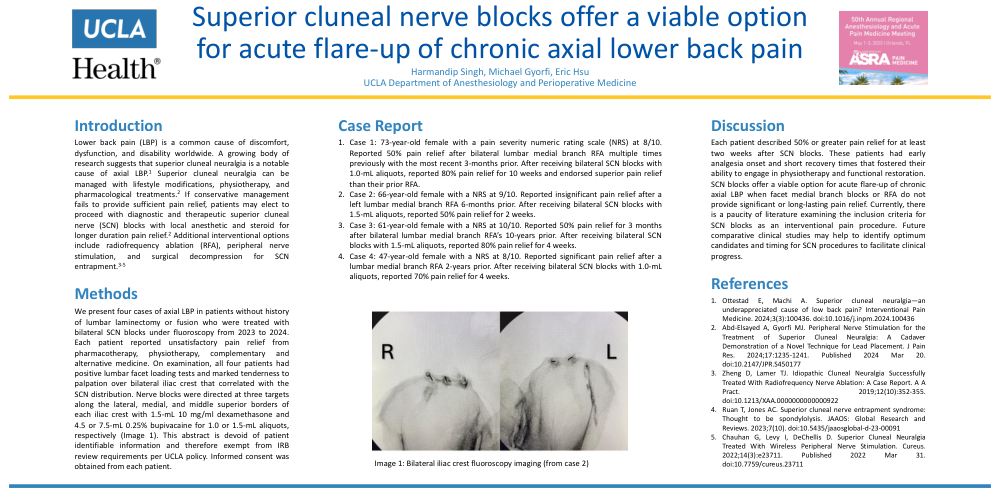
We present four cases of axial LBP in patients without history of lumbar laminectomy or fusion who were treated with bilateral SCN blocks under fluoroscopy from 2023 to 2024. Each patient reported unsatisfactory pain relief from pharmacotherapy, physiotherapy, complementary and alternative medicine. On examination, all four patients had positive lumbar facet loading tests and marked tenderness to palpation over bilateral iliac crest that correlated with the SCN distribution. Nerve blocks were directed at three targets along the lateral, medial, and middle superior borders of each iliac crest with 1.5-mL 10 mg/ml dexamethasone and 4.5 or 7.5-mL 0.25% bupivacaine for 1.0 or 1.5-mL aliquots, respectively (Image 1). This abstract is devoid of patient identifiable information and therefore exempt from IRB review requirements per UCLA policy. Informed consent was obtained from each patient.
Case Report
Each patient described 50% or greater pain relief for at least two weeks after SCN blocks. These patients had early analgesia onset and short recovery times that fostered their ability to engage in physiotherapy and functional restoration. SCN blocks offer a viable option for acute flare-up of chronic axial LBP when facet medial branch blocks or RFA do not provide significant or long-lasting pain relief. Currently, there is a paucity of literature examining the inclusion criteria for SCN blocks as an interventional pain procedure. Future comparative clinical studies may help to identify optimum candidates and timing for SCN procedures to facilitate clinical progress.