383 posters, 2 videos, 1 audios, 8 topics, 28 sessions, 328 authors, 225 institutions
ePostersLive by SciGen Technologies S.A. All rights reserved.
50th Annual Regional Anesthesiology and Acute Pain Medicine Meeting
May 1 - 3, 2025 | Orlando, Florida

6855
RESOLUTION OF EMERGENCY DEPARTMENT NERVE BLOCKS FOR HIP FRACTURES PRIOR TO SURGERY: A RETROSPECTIVE ANALYSIS.
Poster Presenter
Authors
Affiliations
Part of Topic
Scientific Abstracts > Acute Pain
Resolution of Emergency Department Nerve Blocks for Hip Fractures Prior to Surgery: A Retrospective Analysis
Patients who sustain hip fractures are often frail and are at high risk for opioid related adverse events
Early access to ultrasound guided nerve blocks (UGNB) is associated with decreased opioid exposure
Limitations in operating room capacity and need for preoperative optimization may lead to prolonged waiting times
The expanding use of UGNB in the emergency department (ED) is effective for short term outcomes, however, few reports of long term analgesia
It is unknown how many patients’ blocks resolve prior to surgery and if there is any benefit from an acute pain consult prior to surgery
Goal: examine pain trajectories in hip fracture patients who receive UGND in the ED
Primary outcome: opioid consumption before nerve block, during nerve block procedure, and after nerve block leading up to surgical fixation
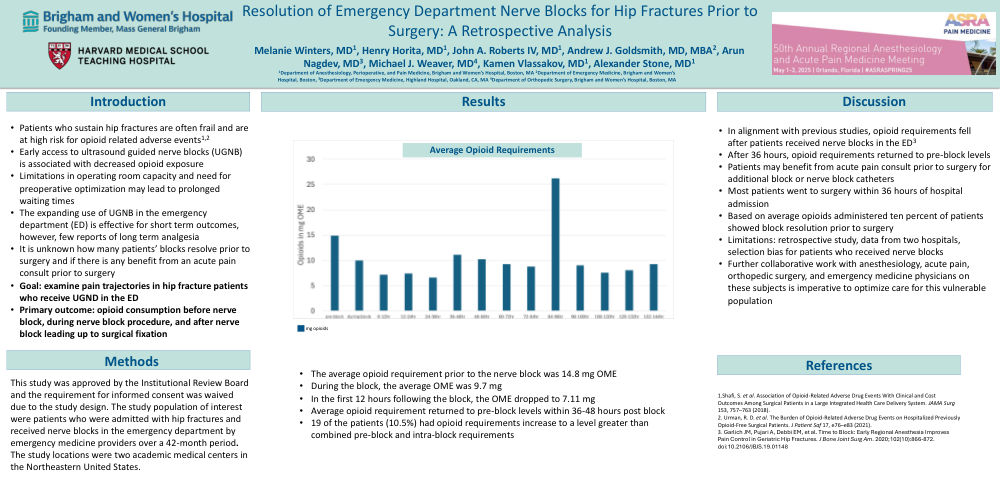
In alignment with previous studies, opioid requirements fell after patients received nerve blocks in the ED
After 36 hours, opioid requirements returned to pre-block levels
Patients may benefit from acute pain consult prior to surgery for additional block or nerve block catheters
Most patients went to surgery within 36 hours of hospital admission
Based on average opioids administered ten percent of patients showed block resolution prior to surgery
Limitations: retrospective study, data from two hospitals, selection bias for patients who received nerve blocks
Further collaborative work with anesthesiology, acute pain, orthopedic surgery, and emergency medicine physicians on these subjects is imperative to optimize care for this vulnerable population