383 posters, 2 videos, 1 audios, 8 topics, 28 sessions, 328 authors, 225 institutions
ePostersLive by SciGen Technologies S.A. All rights reserved.
50th Annual Regional Anesthesiology and Acute Pain Medicine Meeting
May 1 - 3, 2025 | Orlando, Florida

6833
OPIOID CONSUMPTION DURING HOSPITALIZATION ACROSS MANUAL, COMPUTER- AND ROBOTIC-ASSISTED TOTAL HIP ARTHROPLASTY
Poster Presenter
Authors
Affiliations
Part of Topic
Scientific Abstracts > Acute Pain
Introduction: Effective perioperative pain management while limiting opioid consumption
following total hip arthroplasty (THA) is imperative as facilitates immediate postoperative
functionality and better long-term outcomes. While patient characteristics are important factors
associated with analgesia, surgical technique is also relevant. Indeed, robotic-assisted THA (RA-
THA) has been associated with decreased opioid requirements during hospitalization compared
with manual THA (MA-THA). However, there is lack of comparative data accounting for the
RA-THA learning curve and incorporation of computer-assisted THA (CA-THA) as a
comparator group. Thus, we aimed to explore differences in opioid usage during hospitalization
between MA-THA/CA-THA/RA-THA groups in hospitals with at least 1 year of RA-THA
experience.
Materials and Methods: After Institutional Review Board approval (IRB#2012-050), we
queried the Premier Healthcare Database (2016-2023) for adults undergoing elective MA-
THA/CA-THA/RA-THA. We collected patient demographics, hospital characteristics, surgical
indication, length of stay (LOS), opioid consumption (morphine milligram equivalents [MMEs])
and major mechanical and systemic complications during hospitalization. Our primary outcome
was total opioid consumption during hospitalization. Secondary outcomes were opioid
consumption at the day of surgery, postoperative day (POD) 1 and POD ≥2. Using mixed-effects
models (incorporating hospital/surgeon deidentified IDs) we applied pairwise comparisons
between THA techniques, with and without adjusting for all aforementioned covariates. We
reported mean difference (MD) and 95% confidence intervals (CI).
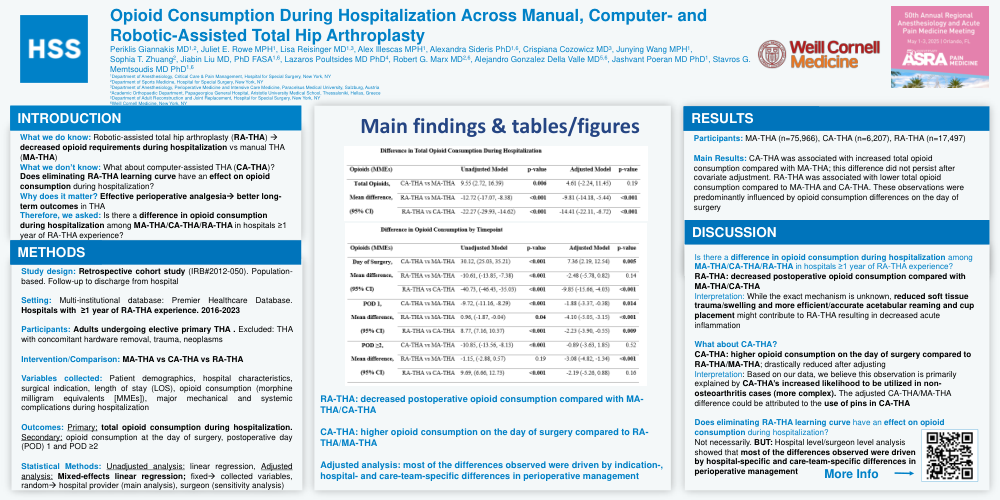
Results: Overall, n= 75,966, n= 6,207, and n= 17,497 MA-THA, CA-THA, and RA-THA cases
were included, respectively (Figure 1, Table 1). In unadjusted analyses, CA-THA was associated
with increased total opioid consumption compared with MA-THA (MD = 9.55, 95% CI 2.72-
16.39; p = 0.006); this difference did not persist after covariate adjustment (MD = 4.61, 95% CI -
2.24-11.45; p = 0.19); Table 2. Additionally, RA-THA was associated with lower total opioid
consumption (adjusted MD = -9.81, 95% CI [-14.18]-[-5.44]; p < 0.001) compared to MA-THA,
as well as when compared to CA-THA (adjusted MD = -14.41, 95% CI [-22.11]-[-6.72]; p <
0.001); Table 2. These observations were predominantly influenced by opioid consumption
differences on the day of surgery (Table 3).
Discussion: Our study supports the existing literature that RA-THA is associated with decreased
postoperative opioid consumption versus MA-THA, and is the first report of RA-THA’s
superiority over CA-THA. While the exact mechanism is unknown, reduced soft tissue
trauma/swelling and more efficient/accurate acetabular reaming and cup placement might
contribute to RA-THA resulting in decreased acute inflammation.
CA-THA was associated with substantially higher opioid consumption on the day of surgery
compared to RA-THA/MA-THA; the magnitude of these differences was drastically reduced
after adjusting. Based on our data, we believe this observation is primarily explained by CA-
THA’s increased likelihood to be utilized in non-osteoarthritis cases (more complex). The
adjusted CA-THA/MA-THA difference could be attributed to the use of pins in CA-THA.
In conclusion, RA-THA was associated with the least total opioid consumption during
hospitalization. CA-THA was associated with the highest opioid requirement on the day of
surgery, which could partially be explained by increased case complexity.