383 posters, 2 videos, 1 audios, 8 topics, 28 sessions, 328 authors, 225 institutions
ePostersLive by SciGen Technologies S.A. All rights reserved.
50th Annual Regional Anesthesiology and Acute Pain Medicine Meeting
May 1 - 3, 2025 | Orlando, Florida

6529
PREVALENCE OF CANNABIDIOL USE IN PATIENTS UNDERGOING SPORTS MEDICINE PROCEDURES ON KNEES, SHOULDERS, OR HIPS: A SURVEY STUDY
Poster Presenter
Authors
Affiliations
Part of Topic
Scientific Abstracts > Acute Pain
Prevalence of cannabidiol use in patients undergoing sports medicine procedures on the knee, shoulder, or hip: A survey study
Authors: Sophia Madjarova BA, Arjun Khorana BS, William Chan MEng, Answorth Allen MD, Riley Williams MD, Benedict Nwachukwu MD MBA, Alexandra Sideris PhD
Introduction
Managing post-operative pain with opioids carries risks, including addiction. A promising alternative gaining attention is cannabidiol (CBD), a non-intoxicating derivative of the cannabis plant that is federally legal in the United States. While current literature predominately focuses on CBD use among patients undergoing joint replacements, a generally older population,[1,2] reports from the National Survey on Drug Use and Health indicate that adults aged 18-35 are the most frequent self-reporters of cannabis use.[3] This study aims to address this potential gap by reporting on the prevalence of self-medication with CBD in the adult population undergoing elective sports medicine procedures on the hip, knee, and shoulder and subjective effects in this often younger and healthier patient population.
Methods
After Institutional Review Board approval, an anonymous 27 item questionnaire was designed by the study team with the purpose of collecting patient demographics and information on familiarity with and use of CBD. Specific measures of interest were patient-reported reasons for use and perceived efficacy of CBD on a Likert scale. Questionnaires were distributed through email via REDCap to adult surgical patients who visited 1 of 3 sports medicine orthopedic surgeons at a single, high-volume orthopedic specialty hospital between September 20, 2024, and December 23, 2024. At the time of abstract submission, data collection was still ongoing, and thus preliminary data are presented here.
Results
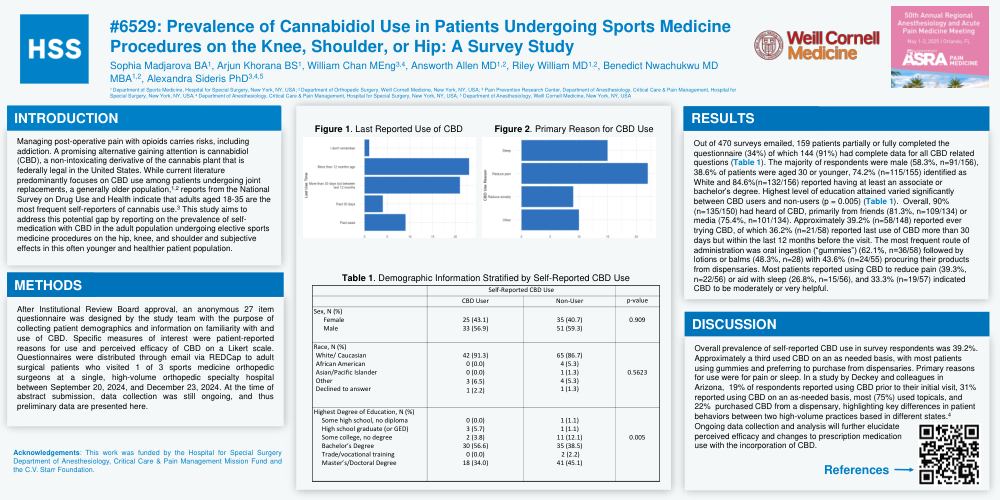
Out of 470 surveys emailed, 159 patients partially or fully completed the questionnaire (34%) of which 144 (91%) had complete data for all CBD related questions (Table 1). The majority of respondents were male (58.3%, n=91/156), 38.6% of patients were aged 30 or younger, 74.2% (n=115/155) identified as White and 84.6%(n=132/156) reported having at least an associate or bachelor’s degree. Highest level of education attained varied significantly between CBD users and non-users (p = 0.005) (Table 1). Overall, 90% (n=135/150) had heard of CBD, primarily from friends (81.3%, n=109/134) or media (75.4%, n=101/134). Approximately 39.2% (n=58/148) reported ever trying CBD, of which 36.2% (n=21/58) reported last use of CBD more than 30 days but within the last 12 months before the visit. The most frequent route of administration was oral ingestion (“gummies”) (62.1%, n=36/58) followed by lotions or balms (48.3%, n=28) with 43.6% (n=24/55) procuring their products from dispensaries. Most patients reported using CBD to reduce pain (39.3%, n=22/56) or aid with sleep (26.8%, n=15/56), and 33.3% (n=19/57) indicated CBD to be moderately or very helpful.
Discussion
The overall prevalence of self-reported CBD use in survey respondents was 39.2%. Approximately a third used CBD on an as-needed basis, with most patients using gummies and 43.6% preferring to purchase from dispensaries. Primary reasons for use were for pain or sleep. In a study by Deckey and colleagues in Arizona, 19% of respondents reported using CBD prior to their initial visit, 31% reported using CBD on an as-needed basis, most (75%) used topicals, and 22% purchased CBD from a dispensary, highlighting key differences in patient behaviors between two high-volume practices based in different states.[4] Ongoing data collection and analysis will further elucidate perceived efficacy and changes to prescription medication use with the incorporation of CBD.
References
1. Yu JS, Premkumar A, Liu S, Sculco P. Rates of Self-Directed Perioperative Cannabidiol use in Patients Undergoing Total Hip or Knee Arthroplasty. Pain Manag. 2021;11(6):655-660.
2. Runner RP, Luu AN, Nassif NA, Scudday TS, Patel JJ, Barnett SL, Gorab RS. Use of Tetrahydrocannabinol and Cannabidiol Products in the Perioperative Period Around Primary Unilateral Total Hip and Knee Arthroplasty. J Arthroplasty. 2020 Jun;35(6S):S138-S143. doi: 10.1016/j.arth.2020.01.077. Epub 2020 Feb 5. PMID: 32173619
3. 2021 National Survey on Drug Use (NSDUH) and Health Releases. Substance Abuse and Mental Health Services Administration (SAMHSA). Published online 2021. https://www.samhsa.gov/data/release/2021-national-survey-drug-use-and-health-nsduh-releases
4. Deckey DG, Doan M, Hassebrock JD, et al. Prevalence of Cannabinoid (CBD) Use in Orthopaedic Sports Medicine Patients. Orthopaedic Journal of Sports Medicine. 2022;10(4):Orthop J Sports Med. doi:10.1177/23259671221087629