383 posters, 2 videos, 1 audios, 8 topics, 28 sessions, 328 authors, 225 institutions
ePostersLive by SciGen Technologies S.A. All rights reserved.
50th Annual Regional Anesthesiology and Acute Pain Medicine Meeting
May 1 - 3, 2025 | Orlando, Florida

6504
CONTINUOUS PERIPHERAL NERVE BLOCKS AND OPIOID USE IN RIB FRACTURE PATIENTS: A RETROSPECTIVE REVIEW FROM A LEVEL 1 TRAUMA CENTER
Poster Presenter
Authors
Affiliations
Part of Topic
Scientific Abstracts > Regional Anesthesia
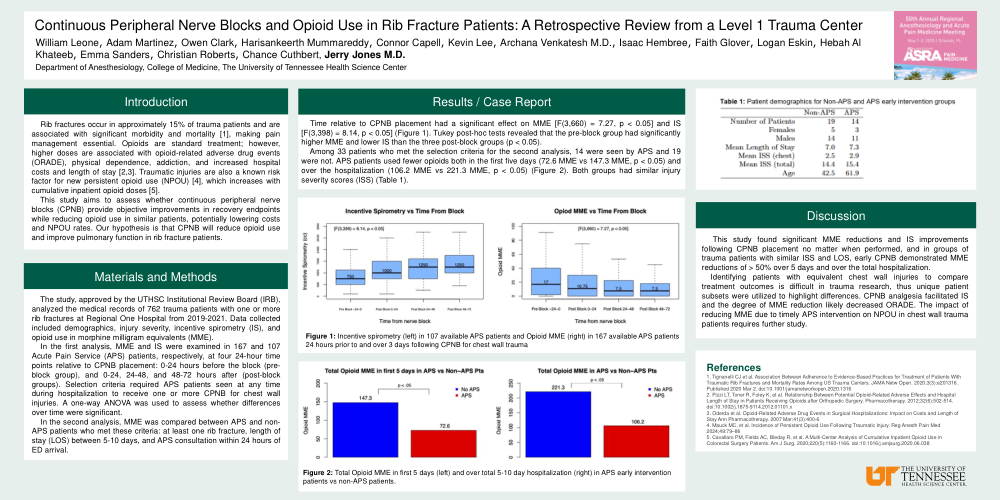
Continuous Peripheral Nerve Blocks and Opioid Use in Rib Fracture Patients: A Retrospective Review from a Level 1 Trauma Center
Introduction
Rib fractures occur in approximately 15% of trauma patients and are associated with significant morbidity and mortality [1], making pain management essential. Opioids are standard treatment; however, higher doses are associated with opioid-related adverse drug events (ORADE), physical dependence, addiction, and increased hospital costs and length of stay [2,3]. Traumatic injuries are also a known risk factor for new persistent opioid use (NPOU) [4], which increases with cumulative inpatient opioid doses [5].
This study aims to assess whether continuous peripheral nerve blocks (CPNB) provide objective improvements in recovery endpoints while reducing opioid use in similar patients, potentially lowering costs and NPOU rates. Our hypothesis is that CPNB will reduce opioid use and improve pulmonary function in rib fracture patients.
Materials and Methods
The study, approved by the UTHSC Institutional Review Board (IRB), analyzed the medical records of 762 trauma patients with one or more rib fractures at Regional One Hospital from 2019-2021. Data collected included demographics, injury severity, incentive spirometry (IS), and opioid use in morphine milligram equivalents (MME).
In the first analysis, MME and IS were examined in 167 and 107 Acute Pain Service (APS) patients, respectively, at four 24-hour time points relative to CPNB placement: 0-24 hours before the block (pre-block group), and 0-24, 24-48, and 48-72 hours after (post-block groups). Selection criteria required APS patients seen at any time during hospitalization to receive one or more CPNB for chest wall injuries. A one-way ANOVA was used to assess whether differences over time were significant.
In the second analysis, MME was compared between APS and non-APS patients who met these criteria: at least one rib fracture, length of stay (LOS) between 5-10 days, and APS consultation within 24 hours of ED arrival.
Results/Case Report
Time relative to CPNB placement had a significant effect on MME [F(3,660) = 7.27, p < 0.05] and IS [F(3,398) = 8.14, p < 0.05] (Figure 1). Tukey post-hoc tests revealed that the pre-block group had significantly higher MME and lower IS than the three post-block groups (p < 0.05).
Among 33 patients who met the selection criteria for the second analysis, 14 were seen by APS and 19 were not. APS patients used fewer opioids both in the first five days (72.6 MME vs 147.3 MME, p < 0.05) and over the hospitalization (106.2 MME vs 221.3 MME, p < 0.05) (Figure 2). Both groups had similar injury severity scores (ISS) (Table 1).
Discussion
This study found significant MME reductions and IS improvements following CPNB placement no matter when performed, and in groups of trauma patients with similar ISS and LOS, early CPNB demonstrated MME reductions of > 50% over 5 days and over the total hospitalization.
Identifying patients with equivalent chest wall injuries to compare treatment outcomes is difficult in trauma research, thus unique patient subsets were utilized to highlight differences. CPNB analgesia facilitated IS and the degree of MME reduction likely decreased ORADE. The impact of reducing MME due to timely APS intervention on NPOU in chest wall trauma patients requires further study.