383 posters, 2 videos, 1 audios, 8 topics, 28 sessions, 328 authors, 225 institutions
ePostersLive by SciGen Technologies S.A. All rights reserved.
50th Annual Regional Anesthesiology and Acute Pain Medicine Meeting
May 1 - 3, 2025 | Orlando, Florida

6834
PARAVERTEBRAL BLOCKS PROVIDE SUPERIOR ANALGESIA TO INTERCOSTAL CRYONEUROABLATION IN MIDCAB SURGERY
Poster Presenter
Authors
Affiliations
Part of Topic
Scientific Abstracts > Regional Anesthesia
Title: Paravertebral blocks provide superior analgesia to intercostal cryoneuroablation in robotic MIDCAB surgery
Introduction:
Minimally invasive direct coronary artery bypass (MIDCAB) surgery offers a less invasive alternative to median sternotomy, with benefits including reduced surgical trauma, faster recovery, and improved patient satisfaction.1,2 However, significant postoperative pain remains a barrier to optimal recovery. Regional techniques such as paravertebral blocks (PVB), intercostal cryoneuroablation (IC), and intercostal nerve blocks (ICNB) are commonly used, but comparative data on their analgesic effectiveness in the MIDCAB population are limited.3,4 This retrospective study evaluates whether ultrasound-guided PVB provides superior postoperative analgesia compared to IC and ICNB, with the goal of improving recovery, reducing opioid use, and shortening hospital stays.
Methods:
A retrospective cohort study was conducted at Duke University Medical Center, reviewing records of patients who underwent MIDCAB surgery between July 2021 and November 2024. Patients were included if they received ultrasound-guided single-shot paravertebral blocks (PVB), intercostal cryoneuroablation (IC), or surgeon-injected intercostal nerve blocks (ICNB) for postoperative analgesia. The primary outcome was opioid consumption (oral morphine equivalents [OME]) intraoperatively and during the first 48 postoperative hours. Secondary outcomes included ICU and total hospital length of stay, and pain scores recorded at ICU admission (t=0) and every 6 hours for 24 hours. Statistical analysis included descriptive statistics; group differences were assessed using the Kruskal-Wallis test, with post-hoc Mann-Whitney U tests and Bonferroni correction when significant. The study was approved by the Duke University Health System Institutional Review Board (Pro00117282).
Results:
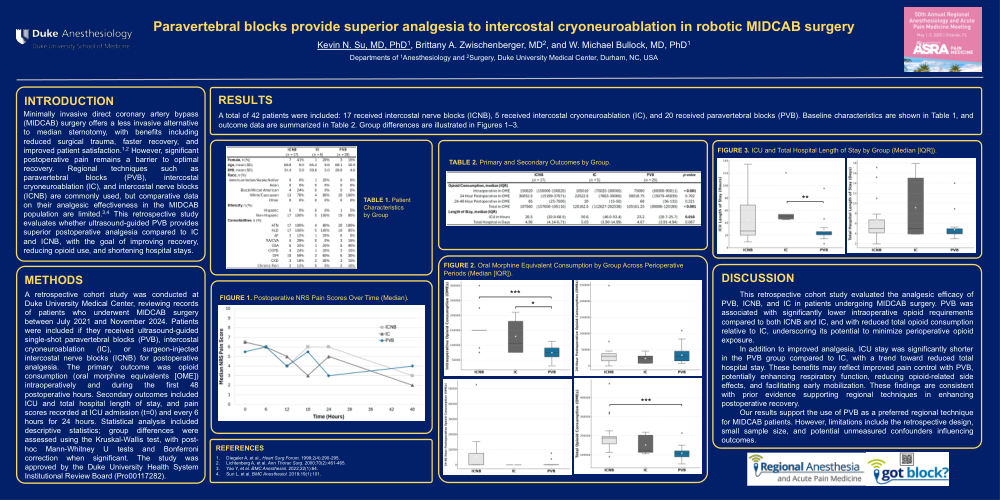
A total of 42 patients were included: 17 received intercostal nerve blocks (ICNB), 5 received intercostal cryoneuroablation (IC), and 20 received paravertebral blocks (PVB). Baseline characteristics are shown in Table 1, and outcome data are summarized in Table 2. Group differences are illustrated in Figures 1–3.
Discussion:
This retrospective cohort study evaluated the analgesic efficacy of PVB, ICNB, and IC in patients undergoing MIDCAB surgery. PVB was associated with significantly lower intraoperative opioid requirements compared to both ICNB and IC, and with reduced total opioid consumption relative to IC, underscoring its potential to minimize perioperative opioid exposure.
In addition to improved analgesia, ICU stay was significantly shorter in the PVB group compared to IC, with a trend toward reduced total hospital stay. These benefits may reflect improved pain control with PVB, potentially enhancing respiratory function, reducing opioid-related side effects, and facilitating early mobilization. These findings are consistent with prior evidence supporting regional techniques in enhancing postoperative recovery.
Our results support the use of PVB as a preferred regional technique for MIDCAB patients. However, limitations include the retrospective design, small sample size, and potential unmeasured confounders influencing outcomes.