383 posters, 2 videos, 1 audios, 8 topics, 28 sessions, 328 authors, 225 institutions
ePostersLive by SciGen Technologies S.A. All rights reserved.
50th Annual Regional Anesthesiology and Acute Pain Medicine Meeting
May 1 - 3, 2025 | Orlando, Florida

6818
ERECTOR SPINAE PLANE BLOCK FOR THORACOSCOPIC SURGERIES: A RETROSPECTIVE STUDY ON NARCOTIC USAGE AND POSTOPERATIVE PAIN CONTROL
Poster Presenter
Authors
Affiliations
Part of Topic
Scientific Abstracts > Regional Anesthesia
Introduction
•Video-assisted thoracoscopic surgery (VATS) has become the preferred approach in thoracic surgery, reducing postoperative pain compared to thoracotomy, which can cause chronic pain in up to 30% of patients five years post-surgery1.
•Regional anesthesia techniques, such as thoracic epidural analgesia (TEA) and paravertebral blocks (PVBs), effectively manage post-thoracotomy pain but are limited by side effects like hypotension, nausea, vomiting, and urinary retention2,3.
•Erector spinae plane blocks (ESPBs), first described in 2016, provide multi-dermatomal anesthesia with a safer profile and fewer side effects than TEA4.5.
•Evidence from open thoracic and cardiopulmonary bypass surgeries suggest that ESPBs reduce narcotic use, shorten hospital stays, and improve respiratory function6,7,8.
•ESPB has been applied successfully in a variety of cardiac procedures including pediatric sternotomy, revascularization, and structural heart surgery as an opioid-sparing analgesic technique, however its role in VATS remains unclear due to limited and mixed study results9,10.
Purpose
•To evaluate the impact of adding Erector Spinae Plane Blocks (ESPBs) to our institutional analgesic protocol for minimally invasive thoracoscopic surgery (VATS).
•To determine whether ESPB reduces intraoperative and postoperative opioid requirements and reliance on hydromorphone PCA while maintaining effective pain control.
•To compare total narcotic usage, postoperative pain scores at 0, 12, and 24 hours, and utilization of patient-controlled analgesia (PCA) hydromorphone between ESPB and non-ESPB groups.
•To clarify ESPB’s role in VATS analgesia and support evidence-based postoperative pain management within enhanced recovery pathways.
Method
•Study Design: Single-center retrospective cohort study conducted at a tertiary academic hospital.
•Patient Selection: Included 418 adult patients who underwent video-assisted thoracoscopic surgery (VATS) between October 2021 and October 2024.
•Group Classification: Patients were categorized into ESPB group (received erector spinae plane block) and No-ESPB group (did not receive ESPB).
•Exclusion Criteria: Patients were excluded for conversion to open surgery, incomplete records, perioperative complications requiring postoperative ventilation, allergies to anesthetics, failed ESPB delivery, neuromuscular disease, preoperative opioid dependence, or receiving other regional blocks.
•Data Collection: Our primary outcome was postoperative hydromorphone PCA usage. Patient demographics, clinical characteristics, intraoperative analgesic use, ESPB details, postoperative pain scores (0, 12, and 24 hours), PACU time, and hospital length of stay were also collected.
•Statistical Analysis: Data analyzed using R version 4.0; normality assessed via Shapiro-Wilk test; Mann-Whitney U test, chi-squared test, Fisher’s exact test, and Kruskal-Wallis test used as appropriate; ; p-value < 0.05 considered statistically significant. Robust regression analysis conducted; β represents the effect size of an independent variable on the dependent variable; sign indicates direction of the relationship; 95% CI exclusion of zero confirms statistical significance.
Results
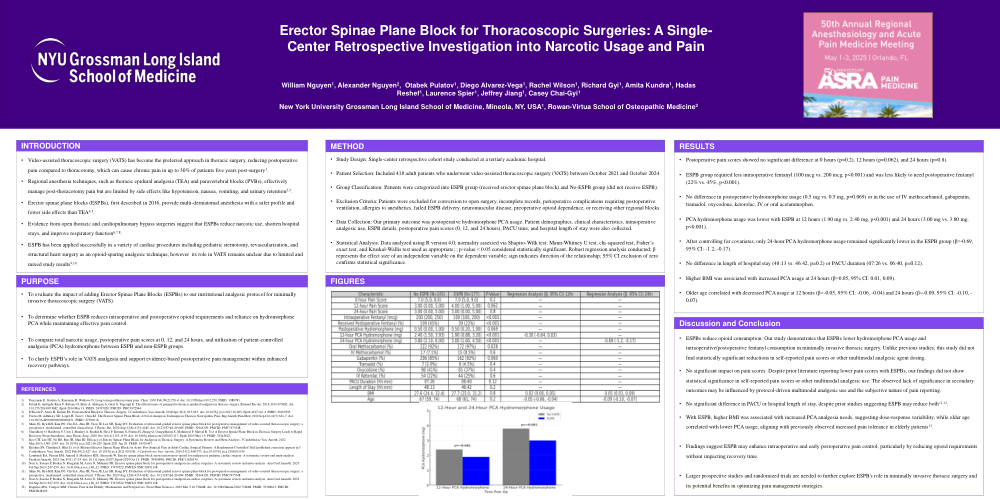
•Postoperative pain scores showed no significant difference at 0 hours (p=0.2), 12 hours (p=0.062), and 24 hours (p=0.8).
•ESPB group required less intraoperative fentanyl (100 mcg vs. 200 mcg, p<0.001) and was less likely to need postoperative fentanyl (22% vs. 45%, p<0.001).
•No difference in postoperative hydromorphone usage (0.5 mg vs. 0.5 mg, p=0.069) or in the use of IV methocarbamol, gabapentin, tramadol, oxycodone, ketorolac, IV or oral acetaminophen.
•PCA hydromorphone usage was lower with ESPB at 12 hours (1.90 mg vs. 2.40 mg, p<0.001) and 24 hours (3.00 mg vs. 3.80 mg, p<0.001).
•After controlling for covariates, only 24-hour PCA hydromorphone usage remained significantly lower in the ESPB group (β=-0.69, 95% CI: -1.2, -0.17).
•No difference in length of hospital stay (48:13 vs. 46:42, p=0.2) or PACU duration (07:26 vs. 06:40, p=0.12).
•Higher BMI was associated with increased PCA usage at 24 hours (β=0.05, 95% CI: 0.01, 0.09).
•Older age correlated with decreased PCA usage at 12 hours (β=-0.05, 95% CI: -0.06, -0.04) and 24 hours (β=-0.09, 95% CI: -0.10, -0.07).
Discussion and Conclusion
•ESPBs reduce opioid consumption: Our study demonstrates that ESPBs lower hydromorphone PCA usage and intraoperative/postoperative fentanyl consumption in minimally invasive thoracic surgery. Unlike previous studies, this study did not find statistically significant reductions in self-reported pain scores or other multimodal analgesic agent dosing.
•No significant impact on pain scores: Despite prior literature reporting lower pain scores with ESPBs, our findings did not show statistical significance in self-reported pain scores or other multimodal analgesic use. The observed lack of significance in secondary outcomes may be influenced by protocol-driven multimodal analgesic use and the subjective nature of pain reporting.
•No significant difference in PACU or hospital length of stay, despite prior studies suggesting ESPB may reduce both11,12.
•With ESPB, higher BMI was associated with increased PCA analgesia needs, suggesting dose-response variability, while older age correlated with lower PCA usage, aligning with previously observed increased pain tolerance in elderly patients13.
•
•Findings suggest ESPB may enhance intraoperative and early postoperative pain control, particularly by reducing opioid requirements without impacting recovery time.
•
•Larger prospective studies and randomized trials are needed to further explore ESPB's role in minimally invasive thoracic surgery and its potential benefits in optimizing pain management strategies.