383 posters, 2 videos, 1 audios, 8 topics, 28 sessions, 328 authors, 225 institutions
ePostersLive by SciGen Technologies S.A. All rights reserved.
50th Annual Regional Anesthesiology and Acute Pain Medicine Meeting
May 1 - 3, 2025 | Orlando, Florida

6375
CONTINUOUS ADDUCTOR CANAL BLOCK FOR BILATERAL TOTAL KNEE ARTHROPLASTY: A RETROSPECTIVE STUDY
Poster Presenter
Authors
Affiliations
Part of Topic
Scientific Abstracts > Regional Anesthesia
Continuous Adductor Canal Block For Bilateral Total knee Arthroplasty: A retrospective study
Authors: Javiera Vargas, Christine Ma, Sharon Peacock, Naveed Siddiqui, Hermann Dos Santos,
Yehoshua Gleicher.
INTRODUCTION
• Total knee arthroplasty is the most common orthopedic surgery in the lower
extremity performed in North America.
• The recovery after bilateral total knee arthroplasty (BTKA) is challenging, given
the need for effective pain control, early mobilization, and safe discharge home
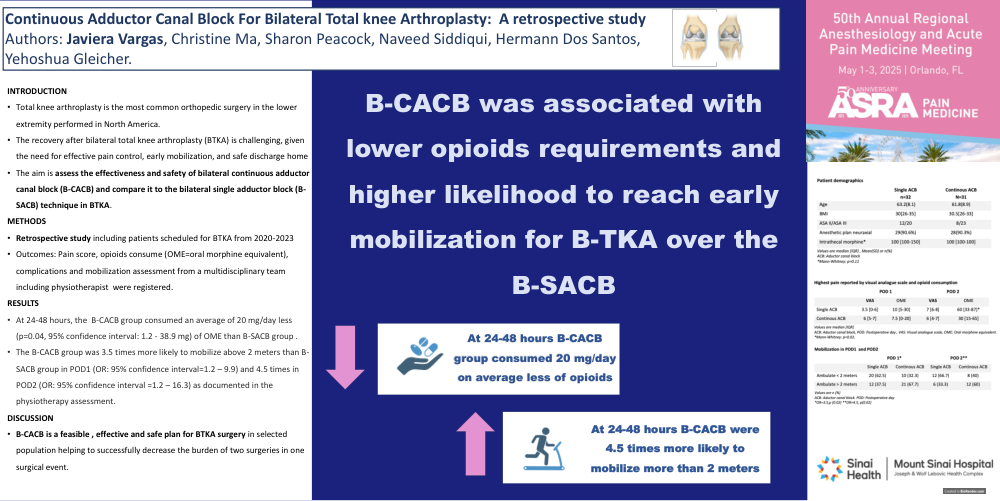
• The aim is assess the effectiveness and safety of bilateral continuous adductor
canal block (B-CACB) and compare it to the bilateral single adductor block (BSACB)
technique in BTKA.
METHODS
• Retrospective study including patients scheduled for BTKA from 2020-2023
• Outcomes: Pain score, opioids consume (OME=oral morphine equivalent),
complications and mobilization assessment from a multidisciplinary team
including physiotherapist were registered.
RESULTS
• At 24-48 hours, the B-CACB group consumed an average of 20 mg/day less
(p=0.04, 95% confidence interval: 1.2 - 38.9 mg) of OME than B-SACB group .
• The B-CACB group was 3.5 times more likely to mobilize above 2 meters than BSACB
group in POD1 (OR: 95% confidence interval=1.2 – 9.9) and 4.5 times in
POD2 (OR: 95% confidence interval =1.2 – 16.3) as documented in the
physiotherapy assessment.
DISCUSSION
• B-CACB is a feasible , effective and safe plan for BTKA surgery in selected
population helping to successfully decrease the burden of two surgeries in one
surgical event.