383 posters, 2 videos, 1 audios, 8 topics, 28 sessions, 328 authors, 225 institutions
ePostersLive by SciGen Technologies S.A. All rights reserved.
50th Annual Regional Anesthesiology and Acute Pain Medicine Meeting
May 1 - 3, 2025 | Orlando, Florida

6824
ACUTE PAIN MANAGEMENT IN ED: KETAMINE VS MORPHINE FOR MUSCULOSKELETAL TRAUMA – A SYSTEMATIC REVIEW AND META-ANALYSIS
Poster Presenter
Authors
Affiliations
Part of Topic
Scientific Abstracts > Acute Pain
ACUTE PAIN MANAGMENT IN ED: KETAMINE VS MORPHINE FOR MUSCULOSKELETAL TRAUMA
A Systematic Review and Meta-Analysis
Gabriel Simoni, Julio S. Curi, Giovanna Susin , Carlos Matheus de Oliveira , Carlos Pereira da Silva, Nayad Braga , Luiza Bressan , Raissa Alana Demarco, Matheus Arraes, MD
BACKGROUND
Nebulized Ketamine is emerging as a viable substitute for morphine in acute pain management..
Previous studies indicate similar biochemical safety profiles for ketamine and morphine.
No comprehensive evaluation comparing efficacy and adverse effects in emergency settings.
This meta-analysis assesses pain relief and adverse outcomes of nebulized ketamine vs. morphine in emergency departments.
METHODS
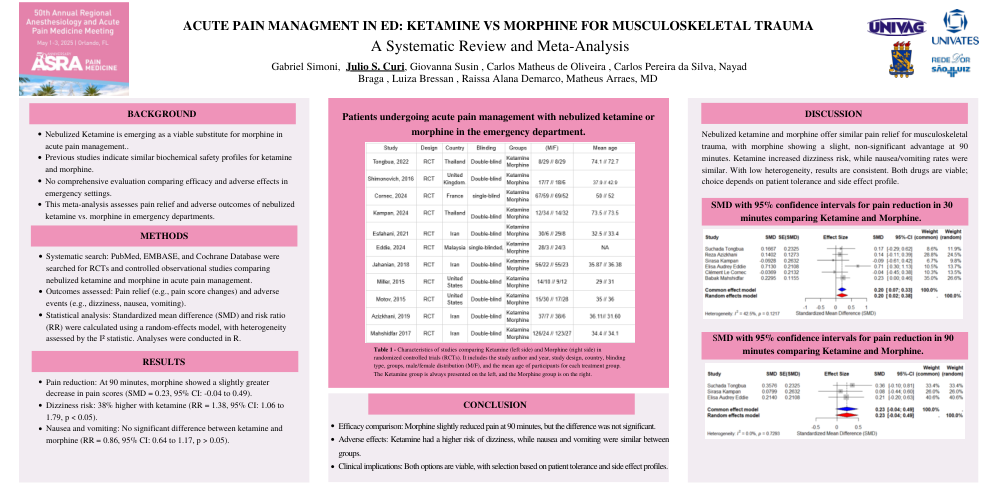
Systematic search: PubMed, EMBASE, and Cochrane Database were searched for RCTs and controlled observational studies comparing nebulized ketamine and morphine in acute pain management. Outcomes assessed: Pain relief (e.g., pain score changes) and adverse events (e.g., dizziness, nausea, vomiting).
Statistical analysis: Standardized mean difference (SMD) and risk ratio (RR) were calculated using a random-effects model, with heterogeneity assessed by the I2 statistic. Analyses were conducted in R.
RESULTS
Pain reduction: At 90 minutes, morphine showed a slightly greater decrease in pain scores (SMD = 0.23, 95% CI: -0.04 to 0.49). Dizziness risk: 38% higher with ketamine (RR = 1.38, 95% CI: 1.06 to 1.79, p < 0.05).
Nausea and vomiting: No significant difference between ketamine and morphine (RR = 0.86, 95% CI: 0.64 to 1.17, p > 0.05).
DISCUSSION
Nebulized ketamine and morphine offer similar pain relief for musculoskeletal trauma, with morphine showing a slight, non-significant advantage at 90 minutes. Ketamine increased dizziness risk, while nausea/vomiting rates were similar. With low heterogeneity, results are consistent. Both drugs are viable; choice depends on patient tolerance and side effect profile.