383 posters, 2 videos, 1 audios, 8 topics, 28 sessions, 328 authors, 225 institutions
ePostersLive by SciGen Technologies S.A. All rights reserved.
50th Annual Regional Anesthesiology and Acute Pain Medicine Meeting
May 1 - 3, 2025 | Orlando, Florida

6725
MANAGEMENT OF CONTINUOUS ERECTOR SPINAE PLANE BLOCKS IN A PATIENT WITH HEMOPHILIA B
Poster Presenter
Authors
Affiliations
Part of Topic
Scientific Abstracts > Regional Anesthesia
Title: MANAGEMENT OF CONTINUOUS ERECTOR SPINAE PLANE BLOCKS IN A PATIENT WITH HEMOPHILIA B
Introduction:
•Thoracic epidural anesthesia (TEA) after major abdominal surgery offers multiple benefits, however, risk of bleeding diathesis may outweigh potential benefits of TEA.1
•In such cases, erector spinae plane (ESP) blocks provide effective abdominal analgesia.
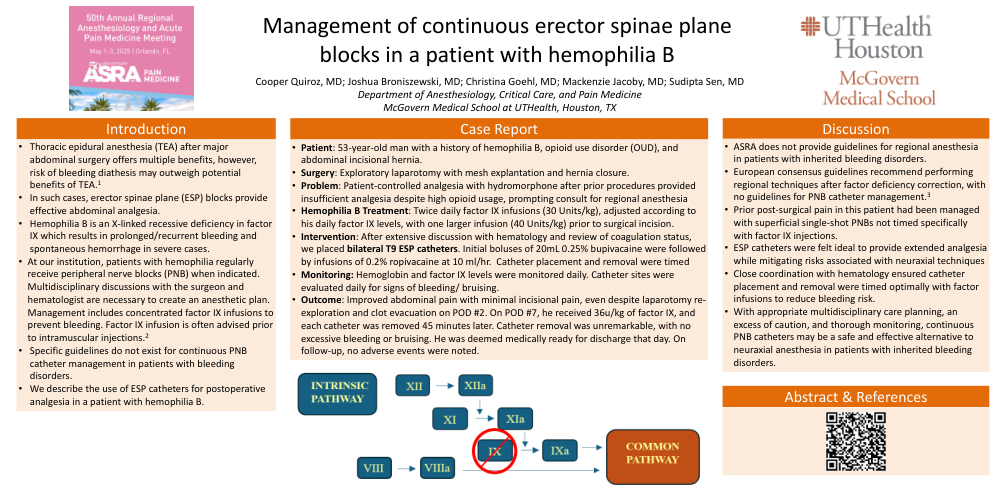
•Hemophilia B is an X-linked recessive deficiency in factor IX which results in prolonged/recurrent bleeding and spontaneous hemorrhage in severe cases.
•At our institution, patients with hemophilia regularly receive peripheral nerve blocks (PNB) when indicated. Multidisciplinary discussions with the surgeon and hematologist are necessary to create an anesthetic plan. Management includes concentrated factor IX infusions to prevent bleeding. Factor IX infusion is often advised prior to intramuscular injections.2
•Specific guidelines do not exist for continuous PNB catheter management in patients with bleeding disorders.
•We describe the use of ESP catheters for postoperative analgesia in a patient with hemophilia B.
Case Report:
•Patient: 53-year-old man with a history of hemophilia B, opioid use disorder (OUD), and abdominal incisional hernia.
•Surgery: Exploratory laparotomy with mesh explantation and hernia closure.
•Problem: Patient-controlled analgesia with hydromorphone after prior procedures provided insufficient analgesia despite high opioid usage, prompting consult for regional anesthesia
•Hemophilia B Treatment: Twice daily factor IX infusions (30 Units/kg), adjusted according to his daily factor IX levels, with one larger infusion (40 Units/kg) prior to surgical incision.
•Intervention: After extensive discussion with hematology and review of coagulation status, we placed bilateral T9 ESP catheters. Initial boluses of 20mL 0.25% bupivacaine were followed by infusions of 0.2% ropivacaine at 10 ml/hr. Catheter placement and removal were timed
•Monitoring: Hemoglobin and factor IX levels were monitored daily. Catheter sites were evaluated daily for signs of bleeding/ bruising.
•Outcome: Improved abdominal pain with minimal incisional pain, even despite laparotomy re-exploration and clot evacuation on POD #2. On POD #7, he received 36u/kg of factor IX, and each catheter was removed 45 minutes later. Catheter removal was unremarkable, with no excessive bleeding or bruising. He was deemed medically ready for discharge that day. On follow-up, no adverse events were noted.
Discussion:
•ASRA does not provide guidelines for regional anesthesia in patients with inherited bleeding disorders.
•European consensus guidelines recommend performing regional techniques after factor deficiency correction, with no guidelines for PNB catheter management.3
•Prior post-surgical pain in this patient had been managed with superficial single-shot PNBs not timed specifically with factor IX injections.
•ESP catheters were felt ideal to provide extended analgesia while mitigating risks associated with neuraxial techniques
•Close coordination with hematology ensured catheter placement and removal were timed optimally with factor infusions to reduce bleeding risk.
•With appropriate multidisciplinary care planning, an excess of caution, and thorough monitoring, continuous PNB catheters may be a safe and effective alternative to neuraxial anesthesia in patients with inherited bleeding disorders.