383 posters, 2 videos, 1 audios, 8 topics, 28 sessions, 328 authors, 225 institutions
ePostersLive by SciGen Technologies S.A. All rights reserved.
50th Annual Regional Anesthesiology and Acute Pain Medicine Meeting
May 1 - 3, 2025 | Orlando, Florida

6604
A COMPARATIVE STUDY BETWEEN EPIDURAL VOLUME EXTENSION IN CSE ANAESTHESIA VS SPINAL ANAESTHESIA FOR ELECTIVE CESAREAN SURGERIES
Poster Presenter
Authors
Affiliations
Part of Topic
Scientific Abstracts > Regional Anesthesia
INTRODUCTION
Single‐shot spinal anesthesia (SSS) and combined spinal‐epidural (CSE) anesthesia are both commonly used for cesarean section in India. The age-old single shot spinal anesthesia provides fast and reliable segmental anesthesia, while epidural anesthesia provides perioperative and postoperative analgesia. The CSEA facilitates the earlier onset of sensory blockade as well as provides postoperative analgesia with the help of epidural catheter thus, incorporating the advantages of spinal and epidural anesthetic techniques. The epidural volume extension (EVE) approach is a variation of Combined spinal epidural anesthesia (CSE), that improves its safety and efficiency(1). In this study, we examined the two different anesthetic techniques for c-section, spinal anesthesia and combined spinal epidural anesthesia
METHODS
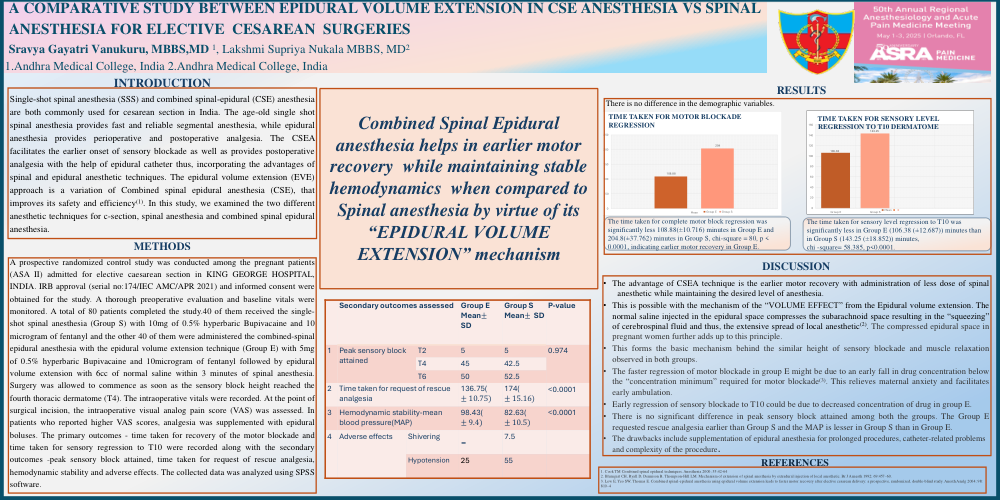
A prospective randomized control study was conducted among the pregnant patients (ASA II) admitted for elective caesarean section in KING GEORGE HOSPITAL, INDIA. IRB approval (serial no:174/IEC AMC/APR 2021) and informed consent were obtained for the study. A thorough preoperative evaluation and baseline vitals were monitored. A total of 80 patients completed the study.40 of them received the single-shot spinal anesthesia (Group S) with 10mg of 0.5% hyperbaric Bupivacaine and 10 microgram of fentanyl and the other 40 of them were administered the combined-spinal epidural anesthesia with the epidural volume extension technique (Group E) with 5mg of 0.5% hyperbaric Bupivacaine and 10microgram of fentanyl followed by epidural volume extension with 6cc of normal saline within 3 minutes of spinal anesthesia. Surgery was allowed to commence as soon as the sensory block height reached the fourth thoracic dermatome (T4). The intraoperative vitals were recorded. At the point of surgical incision, the intraoperative visual analog pain score (VAS) was assessed. In patients who reported higher VAS scores, analgesia was supplemented with epidural boluses. The primary outcomes - time taken for recovery of the motor blockade and time taken for sensory regression to T10 were recorded along with the secondary outcomes -peak sensory block attained, time taken for request of rescue analgesia, hemodynamic stability and adverse effects. The collected data was analyzed using SPSS software.
RESULTS
There is no difference in the demographic variables.
DISCUSSION
• The advantage of CSEA technique is the earlier motor recovery with administration of less dose of spinal anesthetic while maintaining the desired level of anesthesia.
• This is possible with the mechanism of the “VOLUME EFFECT” from the Epidural volume extension. The normal saline injected in the epidural space compresses the subarachnoid space resulting in the “squeezing” of cerebrospinal fluid and thus, the extensive spread of local anesthetic(2). The compressed epidural space in pregnant women further adds up to this principle.
• This forms the basic mechanism behind the similar height of sensory blockade and muscle relaxation observed in both groups.
• The faster regression of motor blockade in group E might be due to an early fall in drug concentration below the “concentration minimum” required for motor blockade(3). This relieves maternal anxiety and facilitates early ambulation.
• Early regression of sensory blockade to T10 could be due to decreased concentration of drug in group E.
• There is no significant difference in peak sensory block attained among both the groups. The Group E requested rescue analgesia earlier than Group S and the MAP is lesser in Group S than in Group E.
The drawbacks include supplementation of epidural anesthesia for prolonged procedures, catheter-related problems and complexity of the procedure.
REFERENCES
1.Cook TM Combined spinal epidural techniques. Anesthesia 2000; 55:42-64
2. Blumgart CH, Ryall D, Dennison B, Thompson-Hill LM. Mechanism of extension of spinal anesthesia by extradural injection of local anesthetic. Br J Anaesth 1992; 69:457–60.
3. Lew E, Yeo SW, Thomas E. Combined spinal-epidural anesthesia using epidural volume extension leads to faster motor recovery after elective cesarean delivery: a prospective, randomized, double-blind study. Anesth Analg 2004; 98: 810–4