383 posters, 2 videos, 1 audios, 8 topics, 28 sessions, 328 authors, 225 institutions
ePostersLive by SciGen Technologies S.A. All rights reserved.
50th Annual Regional Anesthesiology and Acute Pain Medicine Meeting
May 1 - 3, 2025 | Orlando, Florida

6567
ASSESSING THE EFFICACY OF ERECTOR SPINAE PLANE BLOCK IN ONCOLOGY ROBOTIC THORACIC SURGERY: A RETROSPECTIVE PROPENSITY-SCORE STUDY
Poster Presenter
Authors
Affiliations
Sγo Luiz Hospital – ITAIM / Rede D’Or – CMA Anesthesia group
Part of Topic
Scientific Abstracts > Regional Anesthesia
Assessing the Efficacy of Erector Spinae Plane Block in Oncology Robotic Thoracic Surgery: A Retrospective Propensity-Score Study
Matheus de Alencar Arraes, MDb, Sara Amaral, MD, EDRA, DESAICc, Saullo Queiroz Silveira, MDa, Leopoldo Muniz da Silva, MD, PhDb,d, Rafael Sousa Fava Nersessian, MDb, Manoel de Souza Neto, MDb, Caroline Machado Nunes, MDb, Helidea de Oliveira Lima, MD, MsCd, Fernando Nardy Bellicieri, MDa, Anthony M.-H. Ho, MDe, Ricardo Mingarini Terra, MD, PhDa, Glenio B. Mizubuti, MD, PhDe, Rafael Lombardi, MDf
Study Objective: To assess if performing an Erector Spinae Plane Block (ESPB) in combination with multimodal analgesia is effective as an opioid-sparing strategy in robotic-assisted thoracoscopic surgery (RATS).
Design: Dual-center retrospective cohort.
Setting: Tertiary hospital.
Patients: Patients with lung cancer undergoing lung resection by RATS.
Interventions: Patients were grouped according to whether they had received ESPB with general anesthesia (GA) or GA alone.
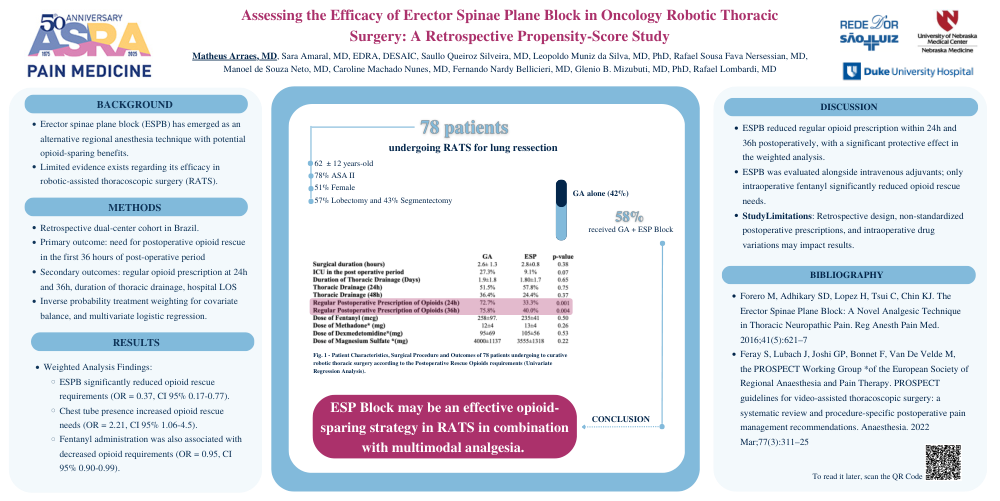
Methods: The primary outcome was the incidence of postoperative rescue opioid requirement in the first 36 hours after surgery. Rescue opioids were only used if moderate to severe pain occurred. Statistical methods included Mann-Whitney U, Chi-squared tests, and IPTW-based propensity score analysis to adjust for covariates like age, ASA classification, and medications. Balance between groups was assessed using standardized differences (<0.1), and analyses were performed in R (v4.0.1).
Results: Of the 86 patients submitted to lung resection by RATS during the study period, 78 were included in the final analysis: 45 received ESPB, and 33 received GA alone. The incidence of postoperative rescue opioid requirement in the first 36 hours after surgery was 33%. There was no statistically significant difference between the groups in the primary outcome in the unadjusted analysis (38% in ESPB vs 27% in GA; p=0.46). Among the patients who required rescue opioids, 12% reported moderate to severe pain within the first postoperative hour (GA 15% vs ESPB 10%; p=0.83). In the weighted analysis, ESPB (OR=0.37, CI 95% 0.17 to 0.77), the administration of fentanyl (OR=0.95, CI 95% 0.90 to 0.99), and the presence of chest tube in the first 24 hours of postoperative period (OR=2.21, CI 95% 1.06 to 4.5) were associated with increased postoperative rescue opioids requirements with statistical significance.
Conclusions: There was no statistically significant difference in postoperative rescue opioid requirement in the first 36h postoperative between the ESPB group and GA group in the unadjusted analysis. However, when the weighted analysis balanced by propensity score was applied, the ESPB group was a protective factor. Thus, the ESPB combined with GA may be associated with a lower risk of postoperative rescue opioid requirements and could potentially serve as an effective opioid-sparing multimodal strategy.
Keywords: Anesthesia; erector spinae plane block; robotic-assisted thoracic surgery.