Loading...

383 posters, 2 videos, 1 audios, 8 topics, 28 sessions, 328 authors, 225 institutions

ePostersLive by SciGen Technologies S.A. All rights reserved.

6821

SPRINT SYSTEM FOR IDIOPATHIC ADHESIVE CAPSULITIS: TWO CASES?
Poster Presenter

Chase Bauer

Part of Topic

Scientific Abstracts > Emerging Technology


SPRINT System for Idiopathic Adhesive Capsulitis: Two Cases

 Chase Bauer1, DO; Alyssa Marulli1, MD

(1) Jefferson Moss-Magee Rehabilitation, Elkins Park, PA, USA


Introduction

•Adhesive capsulitis (shoulder pain and gradual loss of range of motion) has a peak incidence of 55 years of age with a prevalence of 8% in men and 10% in women1.
•Functional impairments can last from 6-24 months.
• Risk factors include diabetes and hypothyroidism1.
• Main stay of treatment is physical therapy
•Steroid injections can have a meaningful reduction in pain and improve range of motion if done at 4-6 weeks or 12-16 weeks2.
•Peripheral nerve stimulation may also be a viable treatment option.
•Here we present two patients with idiopathic adhesive capsulitis who underwent a 60-day SPRINT peripheral nerve stimulator trial.
 

SPRINT System
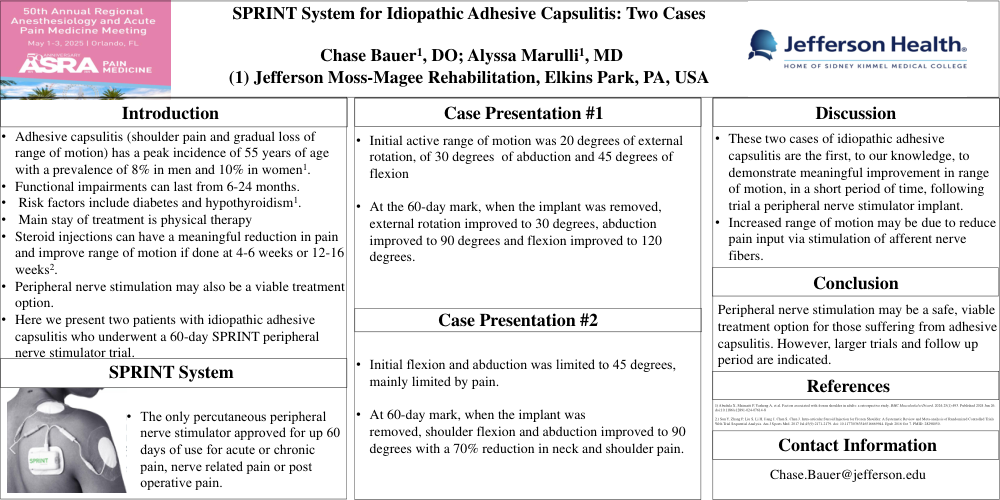
•The only percutaneous peripheral nerve stimulator approved for up 60 days of use for acute or chronic pain, nerve related pain or post operative pain.

Case Presentation #1


•Initial active range of motion was 20 degrees of external rotation, of 30 degrees  of abduction and 45 degrees of flexion


•At the 60-day mark, when the implant was removed, external rotation improved to 30 degrees, abduction improved to 90 degrees and flexion improved to 120 degrees.


Case Presentation #2 

 •Initial flexion and abduction was limited to 45 degrees, mainly limited by pain.•

•At 60-day mark, when the implant was removed, shoulder flexion and abduction improved to 90 degrees with a 70% reduction in neck and shoulder pain.


Discussion:

•These two cases of idiopathic adhesive capsulitis are the first, to our knowledge, to demonstrate meaningful improvement in range of motion, in a short period of time, following trial a peripheral nerve stimulator implant. Increased range of motion may be due to reduce pain input via stimulation of afferent nerve fibers.


Conclusion: 

Peripheral nerve stimulation may be a safe, viable treatment option for those suffering from adhesive capsulitis. However, larger trials and follow up period are indicated.


References:


1) Abudula X, Maimaiti P, Yasheng A, et al. Factors associated with frozen shoulder in adults: a retrospective study. BMC MusculoskeletDisord. 2024;25(1):493. Published 2024 Jun 26. doi:10.1186/s12891-024-07614-8

2.) Sun Y, Zhang P, Liu S, Li H, Jiang J, Chen S, Chen J. Intra-articular Steroid Injection for Frozen Shoulder: A Systematic Review and Meta-analysis of Randomized Controlled Trials With Trial Sequential Analysis. Am J Sports Med. 2017 Jul;45(9):2171-2179. doi: 10.1177/0363546516669944. Epub 2016 Oct 7. PMID: 28298050.


asraspring2025 banner
Copyright © 2015-2026, ePostersLive® SciGen is a registered trademark of SciGen Technologies S.A. Patent pending.

This website and third-party tools we use rely on cookies for the best user experience. By selecting "I agree", you agree to cookie usage as described in our Privacy Policy.
