383 posters, 2 videos, 1 audios, 8 topics, 28 sessions, 328 authors, 225 institutions
ePostersLive by SciGen Technologies S.A. All rights reserved.
50th Annual Regional Anesthesiology and Acute Pain Medicine Meeting
May 1 - 3, 2025 | Orlando, Florida

6386
SIMULATION-BASED COURSES FOR TEACHING LUMBAR PUNCTURE AND ULTRASOUND-ASSISTED TECHNIQUES
Poster Presenter
Part of Topic
Scientific Abstracts > Education
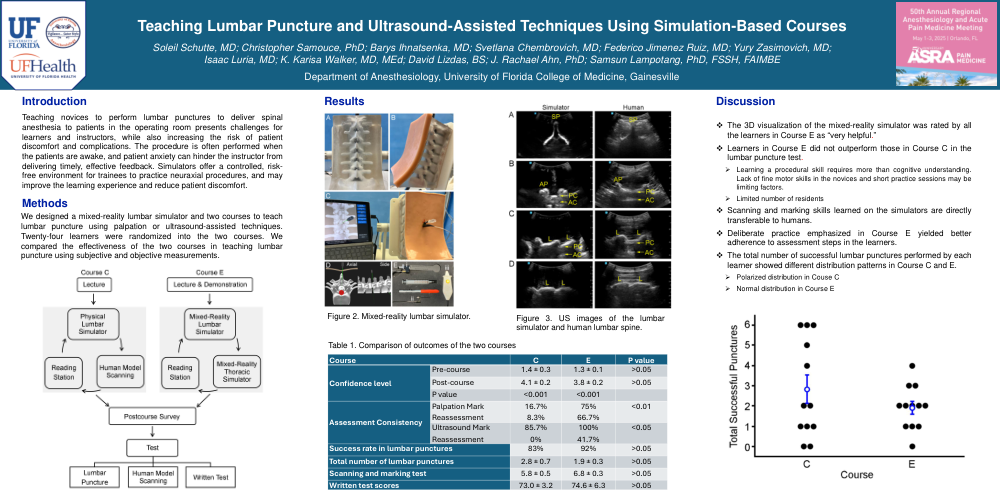
Teaching Lumbar Puncture and Ultrasound-Assisted Techniques Using Simulation-Based Courses
Introduction
Teaching novices to perform lumbar punctures to deliver spinal anesthesia to patients in the operating room presents challenges for learners and instructors, while also increasing the risk of patient discomfort and complications. The procedure is often performed when the patients are awake, and patient anxiety can hinder the instructor from delivering timely, effective feedback. Simulators offer a controlled, risk-free environment for trainees to practice neuraxial procedures, and may improve the learning experience and reduce patient discomfort.
Methods
We designed a mixed-reality lumbar simulator and two courses to teach lumbar puncture using palpation or ultrasound-assisted techniques. Twenty-four learners were randomized into the two courses. We compared the effectiveness of the two courses in teaching lumbar puncture using subjective and objective measurements.
Discussion