383 posters, 2 videos, 1 audios, 8 topics, 28 sessions, 328 authors, 225 institutions
ePostersLive by SciGen Technologies S.A. All rights reserved.
50th Annual Regional Anesthesiology and Acute Pain Medicine Meeting
May 1 - 3, 2025 | Orlando, Florida

6389
A CLINICAL OVERVIEW OF SI-6603 (CONDOLIASE) FOR RADICULAR LEG PAIN ASSOCIATED WITH LUMBAR DISC HERNIATION
Poster Presenter
Authors
Part of Topic
Scientific Abstracts > Chronic Pain
A Clinical Overview of SI-6603 (Condoliase) for Radicular Leg Pain
Associated With Lumbar Disc Herniation
Douglas Beall, MD1; Kenneth Candido, MD2; Kee D. Kim, MD3; Kevin E. Macadaeg, MD4; Anand Patel, MD5; Pragya B. Gupta, MD6; Jose Rivera, MD7; Alan E. Miller, MD8; Ferdinand J. Formoso, DO9;
Kazuhiro Chiba, MD, PhD10; Yukihiro Matsuyama, MD11; Jun Watanabe, RPh, EMBA, MSc12; Takayuki Seo, PhD13; Timothy R. Deer, MD14
1Clinical Radiology of Oklahoma, Edmond, OK, USA; 2Chicago Anesthesia Pain Specialists, Chicago, IL, USA; 3University of California, Davis, Department of Neurological Surgery, Sacramento, CA, USA; 4Indiana Spine Group, Carmel, IN, USA; 5Conquest Research, Winter Park, FL, USA; 6Otrimed Clinical Research, Edgewood, KY, USA; 7Tampa Pain Relief Centers, Tampa, FL, USA; 8Coastal Spine & Pain Center, Fernandina Beach, FL, USA; 9Coastal Spine & Pain Center, Jacksonville, FL, USA; 10National Defense Medical College, Tokorozawa, Saitama, Japan; 11Department of Orthopedic Surgery, Hamamatsu University School of Medicine, Hamamatsu, Japan; 12Seikagaku North America Corporation, Toronto, ON, Canada; 13Clinical Development Department, Research & Development Division, Seikagaku Corporation, Tokyo, Japan; 14The Spine and Nerve Center of the Virginias, Charleston, WV, USA
INTRODUCTION
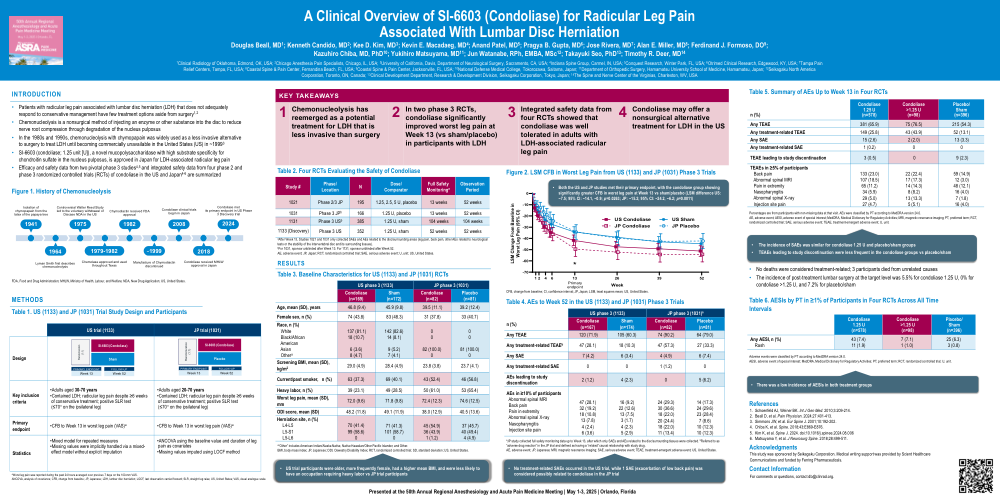
Patients with radicular leg pain associated with lumbar disc herniation (LDH) that does not adequately respond to conservative management have few treatment options aside from surgery1,2
Chemonucleolysis is a nonsurgical method of injecting an enzyme or other substance into the disc to reduce nerve root compression through degradation of the nucleus pulposus
In the 1980s and 1990s, chemonucleolysis with chymopapain was widely used as a less invasive alternative to surgery to treat LDH until becoming commercially unavailable in the United States (US) in ~19993
SI-6603 (condoliase; 1.25 unit [U]), a novel mucopolysaccharidase with high substrate specificity for chondroitin sulfate in the nucleus pulposus, is approved in Japan for LDH-associated radicular leg pain
Efficacy and safety data from two pivotal phase 3 studies4,5 and integrated safety data from four phase 2 and phase 3 randomized controlled trials (RCTs) of condoliase in the US and Japan4-6 are summarized
Figure 1. History of Chemonucleolysis
METHODS
Table 1. US (1133) and JP (1031) Trial Study Design and Participants
Table 2. Four RCTs Evaluating the Safety of Condoliase
RESULTS
Table 3. Baseline Characteristics for US (1133) and JP (1031) RCTs
Figure 2. LSM CFB in Worst Leg Pain from US (1133) and JP (1031) Phase 3 Trials
Table 4. AEs to Week 52 in the US (1133) and JP (1031) Phase 3 Trials
Table 5. Summary of AEs Up to Week 13 in Four RCTs
No deaths were considered treatment-related; 3 participants died from unrelated causes
The incidence of post-treatment lumbar surgery at the target level was 5.5% for condoliase 1.25 U, 0% for condoliase >1.25 U, and 7.2% for placebo/sham
Table 6. AESIs by PT in ≥1% of Participants in Four RCTs Across All Time Intervals
KEY TAKEAWAYS
1) Chemonucleolysis has reemerged as a potential treatment for LDH that is less invasive than surgery
2) In two phase 3 RCTs, condoliase significantly improved worst leg pain at Week 13 (vs sham/placebo) in participants with LDH
3) Integrated safety data from four RCTs showed that condoliase was well tolerated in adults with LDH-associated radicular leg pain
4) Condoliase may offer a nonsurgical alternative treatment for LDH in the US
REFERENCES
For comments or questions, contact db@clinrad.org.